
Key Takeaways
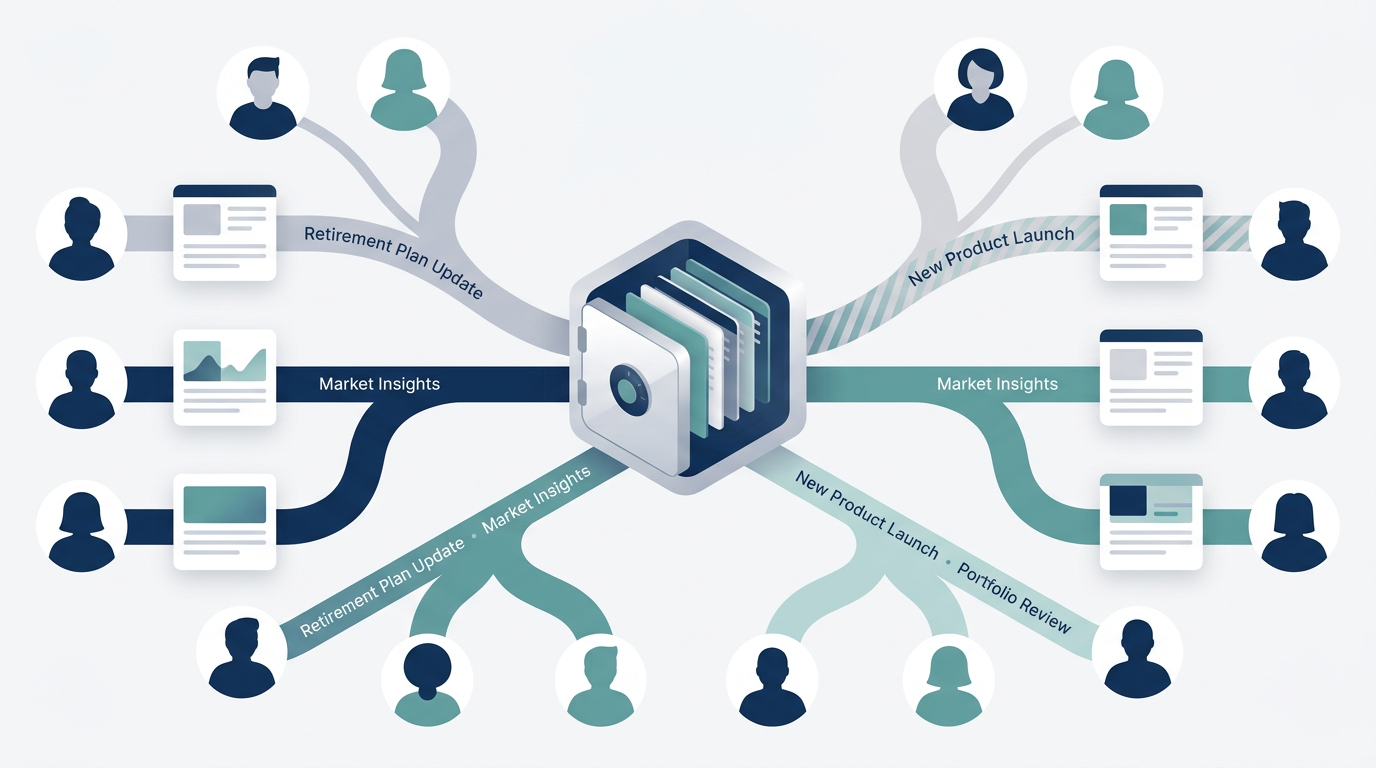
- A central content library is not a shared drive or CRM template folder. It is a governed infrastructure layer that connects compliance workflows, advisor permissions, segmentation logic, and usage analytics in one system.
- The two most common content models (DIY advisor writing and locked-down centralized content) both fail at scale for different reasons, and most firms are unknowingly living with the costs of one or both.
- Personalization and compliance are not opposites when content is built with modular blocks, pre-approved language, and role-based editing permissions that give advisors flexibility within defined guardrails.
- Advisor adoption is the most common failure point in content library deployments, not technology. The firms that solve for discoverability and workflow fit see meaningfully higher utilization rates.
- The firms gaining ground on client communication are treating it as repeatable infrastructure, not a series of one-off tasks.
The Communications Paradox Facing Advisory Firms Today
Every senior leader in wealth management currently faces a version of the same problem: clients expect more personalized, relevant communication than ever before, and the regulatory environment has never been more scrutinizing of how advisors produce and distribute that communication. Those two pressures do not resolve easily. They create a paradox that most firms have not yet solved at scale.
The demand side is clear. Clients, particularly high-net-worth and mass-affluent segments, now benchmark their advisor relationships against the personalized digital experiences they receive from every other category of service provider. They notice when communications feel templated, generic, or poorly timed. Firms in this situation commonly report that advisors who communicate consistently and with relevance retain clients at higher rates and generate more referrals. The business case for better client communication is not theoretical.
The supply side is where the system breaks down. Most firms cannot produce personalized communications at the volume and cadence clients now expect without either overwhelming their compliance review queues or accepting a level of brand and regulatory risk that leadership is not comfortable carrying. The result is a kind of communication paralysis: firms know they should be doing more, but the infrastructure to do it safely does not exist yet. FMEX was built specifically to address this gap, offering an original financial content library designed to support compliant advisor communication programs across distributed advisor forces.
Why Firms Want More Advisor Communication But Fear Letting Advisors Write Freely
The tension here is not hypothetical. Under FINRA Rule 2210, all retail communications must be supervised, and principal approval requirements apply broadly across correspondence and advertising categories. The SEC Marketing Rule (206(4)-1) imposes its own requirements on investment advisers, including substantiation standards and strict rules around testimonials and performance claims. When advisors write their own content without a structured review process, firms cannot consistently meet those standards across a large, distributed workforce. One unapproved email or a social post with an unsubstantiated performance implication can create examination findings that carry firm-wide consequences.
At the same time, advisors who are restricted to a narrow set of pre-approved communications, or who have no practical access to content they can actually use, tend to communicate less frequently and less effectively. The compliance-driven impulse to lock everything down solves one problem while quietly creating another: advisors who are disengaged from marketing, clients who feel underserved, and a pipeline that stagnates.
The Hidden Cost of Personalization: Time Burden and Review Bottlenecks
Consider a hypothetical mid-size broker-dealer with 80 advisors. If each advisor spends an average of three hours per week writing, editing, or searching for client-facing content, that represents 240 advisor-hours per week, time that is not being spent on client meetings, financial planning, or business development. Multiply that across a year, and the operational cost of DIY content production is significant, even before accounting for the compliance review time on the back end.
Review bottlenecks compound the problem. Compliance teams at most firms are not staffed to provide fast turnaround on high volumes of individually written advisor content. When review queues back up, advisors either wait (losing the timeliness that makes communications effective) or they stop submitting content for review altogether, which is a worse outcome from a regulatory standpoint. A central content library with pre-approved, role-appropriate content is designed to reduce this burden without removing the supervisory layer.
What Clients Now Expect in Terms of Cadence, Relevance, and Responsiveness
The expectations gap is widening. Clients who receive quarterly generic newsletters alongside daily personalized notifications from their bank’s mobile app are making implicit comparisons. Firms that communicate only during market volatility or at account review time are missing the relationship touchpoints that build retention and deepen trust. Research consistently shows that consistent, relevant communication (not just volume) is what clients describe as feeling cared for by their advisor. The bar is not perfection; it is consistency and relevance delivered through a sustainable, supervised process.
Why Traditional Content Approaches Cannot Scale
Before examining what a governed content library enables, it is worth being specific about why the current approaches are failing. Most firms are operating one of two models, or an inefficient hybrid of both, and neither was designed for the communication volume and compliance scrutiny that firms now face.
The DIY Model: Hours Lost Per Advisor Writing One-Off Emails
In the DIY model, advisors write their own emails, social posts, and client letters from scratch. Some are skilled communicators; most are not, and should not be expected to be. The content quality is inconsistent, the time cost is high, and the compliance exposure is real. Advisors who improvise content, especially on market commentary, portfolio performance, or product recommendations, frequently create communications that require significant revision or cannot be approved at all. The DIY model may feel like it gives advisors control, but in practice it produces fragmentation, delays, and regulatory risk.
The Locked-Down Model: Centralized Content Advisors Ignore
The overcorrection to DIY is a centralized content model where marketing produces a library of approved content and advisors are expected to use it as-is. The compliance logic is sound, but the adoption results are not. Advisors who cannot personalize content to their client relationships, who cannot find what they need quickly, or who perceive the content as generic or irrelevant simply do not use it. Shelfware is the predictable outcome. Firms in this situation commonly report that utilization rates for centrally produced content fall below 20 percent within six months of launch.
Compliance Exposure When Advisors Improvise or Repurpose Unapproved Content
When advisors feel that approved content does not meet their needs, they adapt it, sometimes in ways that introduce claims, comparisons, or language that the original approval did not cover. An advisor who edits a pre-approved market commentary piece to add a specific return reference, or who repurposes a client newsletter as a social post without understanding that the channel carries different regulatory treatment, creates a supervision gap that may not surface until an examination. The risk is not that advisors are acting in bad faith; it is that the system is not designed to prevent these adaptations from happening in the first place.
Brand Inconsistency Across a Distributed Advisor Force
Beyond compliance, unsupervised content production creates brand fragmentation that erodes firm-level trust. Clients who receive communications from two advisors at the same firm, or who compare what they receive to what a friend describes from the same firm, will notice differences in voice, quality, and consistency. For enterprise wealth organizations and broker-dealers trying to build a recognizable brand at scale, this inconsistency is a material problem that a governed content library is specifically designed to reduce.
What a Central Content Library Actually Enables
The phrase “content library” is used loosely in financial services marketing discussions, and it is worth being precise about what a governed, purpose-built library actually does, because the gap between a well-structured library and a shared folder of PDFs is significant.
What a Governed Content Library Is (and What It Is Not)
A central content library, in the context of advisor communications infrastructure, is a curated, regularly updated collection of original financial content that has been developed with compliance review built into the production process, not bolted on afterward. It is organized for advisor discoverability, tagged by client segment and use case, and integrated with distribution and archiving workflows so that content can move from library to advisor to client without creating gaps in the supervisory record.
What it is not: a repository of PDFs that marketing uploads quarterly and advisors are expected to find on their own. It is not a CRM attachment folder, a Dropbox link, or a collection of externally licensed third-party articles. A properly built library is a living system with defined governance roles, version control, approval status tracking, and usage data that informs what gets created next.
It is also not a compliance shortcut. Firms using a content library remain fully responsible for their supervisory programs, for ensuring that communications are appropriate for the specific clients receiving them, and for maintaining records that meet SEC and FINRA retention requirements. The library is an enabling infrastructure, not a regulatory guarantee.
How It Differs From a Shared Drive, CRM Template Folder, or One-Off Content Purchase
The distinction matters operationally. A shared drive has no governance layer: anyone can edit, move, or delete content, and there is no approval status attached to individual pieces. A CRM template folder may have version control, but it typically lacks the segmentation logic, compliance workflow integration, and usage analytics that make content actionable at scale. One-off content purchases (buying a batch of articles from a third-party provider) solve a short-term volume problem but do not create a sustainable system, and they frequently lack the specific compliance context that financial services content requires. A purpose-built library addresses all three gaps simultaneously.
The Three Layers That Make a Library Work: Governance, Segmentation, and Usage Analytics
The firms that get the most operational value from a central content library tend to build around three distinct functional layers, each of which supports the others:
Governance layer: Defines who can create, approve, edit, and archive content. Includes approval workflows, version history, and integration with archiving systems to support FINRA Rule 2210 and SEC Marketing Rule supervision requirements. This layer is what separates a compliant library from a shared drive.
Segmentation layer: Tags content by client profile (life stage, wealth tier, risk profile, need state), by channel (email, social, print, presentation), and by campaign type (market commentary, planning topic, life event). This is what makes content discoverable and usable for advisors serving different client segments.
Usage analytics layer: Tracks which content advisors are using, which is being ignored, which drives client engagement, and how engagement connects to downstream business activity such as scheduled meetings or referral conversations. This layer is what allows the library to improve over time rather than becoming stale.
Each layer requires deliberate design. Firms that build the governance layer but skip segmentation end up with a compliant but unusable library. Firms that build segmentation without governance create adoption without supervision. All three layers working together is what produces a system that scales.
Building Personalization Into a Scalable System
The assumption that personalization and scale are fundamentally in tension is one of the most persistent (and most costly) beliefs in advisor marketing. It comes from a reasonable place: if personalization requires individual attention, and scale requires volume, then doing both simultaneously seems to demand resources that most firms do not have. But that framing assumes personalization means writing something unique for every client, every time. It does not. It means delivering the right content to the right client at the right moment, through a channel that feels relevant to their situation.
Segment-level personalization (matching content to a client’s life stage, wealth tier, or planning concern) delivers the relevance clients notice most, without requiring individual customization of every piece.
Advisor-level localization (allowing advisors to add a personal note, adjust a subject line, or select from a curated set of pre-approved content) creates a sense of relationship without opening the door to compliance exposure.
Trigger-based delivery (sending content based on a client life event, portfolio milestone, or market condition) makes timing feel personal even when the underlying content is standardized.
Channel-appropriate formatting (ensuring the same core message is available in email, print, and social formats) allows advisors to meet clients where they are without producing separate content for each channel.
None of these approaches require writing from scratch. All of them require a content library that is built with segmentation and workflow in mind from the start. The infrastructure question is not whether personalization is possible at scale; it is whether the system has been designed to support it.
Firms that crack this do not do it by hiring more writers or adding more compliance reviewers. They do it by changing the production model: shifting from advisor-driven, one-off content creation to a library-and-permissions model where the heavy lifting of content development and compliance review happens once, and the distribution work happens at scale. That structural shift is what makes the math work.
How to Segment Clients by Life Stage, Wealth Tier, or Need State Before Building Content Streams
Segmentation is the foundation of scalable personalization, and it is where most firms underinvest before building a content library. The temptation is to start with content (to build the library first and figure out the audience mapping later). That produces a library that is comprehensive but not usable, because advisors cannot quickly identify which pieces are relevant to which clients. Effective segmentation starts with a clear taxonomy of client profiles that maps directly to the content architecture. The most practical frameworks for wealth management firms typically organize around three to four dimensions: life stage (accumulation, pre-retirement, distribution), wealth tier (mass affluent, high-net-worth, ultra-high-net-worth), primary planning concern (tax efficiency, estate transfer, income generation, business succession), and relationship stage (prospect, new client, established client). Content built against that matrix gives advisors a practical navigation system, not just a content dump.
Modular Content Blocks and Personalization Tokens That Maintain Voice While Allowing Local Adaptation
One of the most effective structural approaches to scalable personalization is modular content architecture: building individual pieces as composable blocks rather than monolithic articles or emails. A market commentary piece, for example, might have a fixed core section covering the macro environment, a swappable section that can be adapted for equity-focused versus fixed-income-focused clients, and an open local block where an advisor can add a brief, pre-approved personal observation. The compliance review covers the fixed and swappable sections; the local block operates under defined guardrails (word count limits, approved language categories, and prohibited topics) that are enforced at the platform level.
Personalization tokens work similarly. A pre-approved email template that includes a client’s first name, their advisor’s name and photo, and a subject line drawn from a pre-approved list feels meaningfully more personal than a mass broadcast, without requiring any additional compliance review beyond what was done when the template was originally approved. These are not new techniques, but they are underused in financial services because most firms have not built the library infrastructure that makes them operationally feasible at scale.
Pre-Approved Playlists and Advisor Permissions: Balancing Flexibility With Control
Pre-approved content playlists (curated sets of content organized around a specific client segment, campaign theme, or advisor use case) solve one of the most common adoption problems: advisors who do not know where to start. When an advisor serving a concentration of pre-retirees can navigate directly to a playlist of approved content relevant to Social Security timing, Medicare planning, and income sequencing, the barrier to consistent communication drops significantly. Paired with role-based permissions that define exactly what each advisor can edit, personalize, or send without additional review, playlists create a practical balance between advisor autonomy and supervisory control. The compliance team defines the guardrails once; advisors operate within them at scale.
The Operating Model Behind Governed Content at Scale
Technology enables a governed content library, but technology alone does not make it work. The operating model (the roles, workflows, approval processes, and governance norms that surround the platform) is what determines whether the library becomes a genuine communications infrastructure or a well-designed system that nobody uses. Firms that deploy a content library without building the operating model around it are among the most common sources of adoption failures in this category.
Compliance and Approval Workflows
The approval workflow is the compliance team’s primary interface with the content library, and it needs to be designed with their constraints in mind, not just marketing’s preferences. Compliance teams at most wealth firms are managing a high volume of review requests with limited bandwidth. A content library that routes every piece of content through a sequential, manual review process will create the same bottlenecks that plagued the DIY model, just with better-organized content waiting in the queue. The most functional approval workflows in this context are built around pre-approval categories: content types and topics that, once approved at the template or framework level, can be deployed by advisors within defined parameters without triggering individual review each time.
How Content Gets Vetted, Versioned, and Archived to Meet FINRA Rule 2210 and SEC Marketing Rule Expectations
FINRA Rule 2210 requires that retail communications be approved by a registered principal before use, and that records be retained for a period of three years from the date of last use, with the first two years in an easily accessible location. The SEC Marketing Rule imposes substantiation requirements, prohibits certain performance presentations without appropriate context, and requires that testimonials and endorsements meet specific disclosure standards. A governed content library is designed to support these requirements, not to replace the supervisory program that fulfills them.
Version control is a critical operational component. When a piece of content is updated (because a regulatory change requires revised disclosures, or because market conditions make prior commentary inaccurate), the library needs to retire the prior version, flag advisors who have used it, and make the updated version immediately available. Firms that manage this manually, through email notifications and shared drive updates, routinely experience gaps where outdated content continues to circulate after it has been superseded. A version-controlled library with automated retirement and notification workflows reduces that risk materially.
Archiving integration is equally important. Every communication sent through the library (whether email, social, or print) needs to be captured in the firm’s books and records system in a format that is retrievable for examination. This is not a feature to configure after launch; it is a requirement that should drive platform selection and implementation design from the start. Firms remain responsible for ensuring that their archiving systems meet applicable retention standards, and that records are available for production during regulatory examinations.
Role-Based Permissions: Who Can Edit, Personalize, and Send
A functional permissions architecture typically defines at least four distinct roles: content creators (marketing or a platform’s content team) who build and submit content for review; compliance reviewers who approve, annotate, or reject submissions; advisors who access approved content and operate within defined personalization parameters; and administrators who manage the library taxonomy, usage reporting, and system configuration. The key design principle is that each role has access only to the functions appropriate to its accountability: advisors cannot edit approved content beyond the parameters defined by compliance, and compliance reviewers have a clear audit trail of every modification made between original submission and final approval.
Content Organization and Discoverability
A library that advisors cannot navigate quickly is a library advisors will not use. Discoverability is not a secondary concern; it is one of the primary determinants of adoption. Firms that have invested heavily in content production but minimally in taxonomy and search functionality routinely see the utilization patterns described earlier: high initial awareness, rapid drop-off in actual use, and eventual reversion to DIY content habits. The organization layer of the library deserves the same strategic attention as the content production layer.
Taxonomy That Mirrors How Advisors Think: By Segment, Campaign Type, or Channel
The most advisor-friendly content taxonomies are organized around the questions advisors actually ask when looking for content, not around the categories that are convenient for marketing to produce. An advisor does not typically think “I need a piece from the retirement planning category.” They think “I have a client turning 62 who is asking about Social Security timing, and I want to send her something relevant before our next meeting.” A taxonomy that maps to that mental model (organized by client situation, life event, and planning concern, with secondary filters for channel and format) reduces time-to-send and increases the likelihood that advisors will reach for the library instead of writing something themselves.
Search, Tagging, and Recommended Content Features That Reduce Time to Send
Beyond taxonomy, intelligent search and recommendation features meaningfully reduce the friction that leads to non-adoption. When an advisor can type a keyword (“RMD,” “concentrated stock,” “market volatility”) and receive a ranked list of pre-approved, segment-appropriate content within seconds, the library becomes a practical time-saving tool rather than an obligation. Recommendation engines that surface content based on an advisor’s client profile data or recent communication history can further reduce decision friction and increase the consistency of communication cadences across a practice.
Measurement and Refinement
A governed content library that does not produce measurable business outcomes will eventually lose internal support, regardless of how well it is built. The measurement framework needs to answer three distinct questions: Are advisors using the library? Is the content generating client engagement? Is that engagement connecting to downstream business activity? Each question requires different data, and most firms focus too heavily on the first question (utilization rates) while underinvesting in the second and third.
Utilization data tells you whether advisors are accessing and sending content. It does not tell you whether that content is serving clients well or whether it is supporting the advisor’s business development objectives. A library where 80 percent of advisors are using it but all of them are sending the same three pieces to every client is not performing as intended, even though the utilization number looks strong. Content engagement data (open rates, click-through rates, response rates) adds the next layer of signal. Business outcome data, connecting content engagement to scheduled meetings, new planning conversations, or referral activity, is the most valuable and the hardest to capture consistently.
Firms that build measurement frameworks into their library implementation from the start (defining the metrics, establishing the data connections, and building reporting into advisor and management dashboards) are meaningfully better positioned to demonstrate ROI, refine the content mix over time, and make the case for continued investment in the library infrastructure. Those that treat measurement as a post-launch consideration typically find themselves, twelve months in, unable to answer the question their CFO is asking: is this working?
Tracking What Content Advisors Actually Use and What Drives Client Meetings
Usage tracking at the advisor level reveals patterns that aggregate reporting obscures. Which advisors are high utilizers? Which segments of content are being ignored? Are there regional or channel-specific patterns in how advisors engage with the library? This granular data is valuable both for refining the library and for identifying advisors who may benefit from additional support or training. An advisor who has not used the library in 90 days is not just a utilization statistic; they are likely still producing unapproved content on their own, or communicating with clients less frequently than the firm’s communication standards recommend.
Meeting attribution (connecting a specific content send to a subsequent client meeting) is not always straightforward, but it is achievable with the right CRM integration and advisor reporting habits. Firms in this situation commonly report that advisors who communicate consistently with relevant, timely content schedule client reviews at higher rates than those who communicate sporadically. Results vary, and attribution is never perfect, but the directional signal is consistent enough to inform both content strategy and advisor coaching conversations.
Linking Content Engagement to Pipeline and AUM Outcomes, Not Just Opens and Clicks
The most sophisticated measurement frameworks in this space connect content engagement data to CRM pipeline data, tracking whether clients who engage with specific content types are more likely to schedule a meeting, accept a planning proposal, or make a referral. This is not easy to build, and it requires both technical integration and consistent advisor data hygiene. But for firm leaders trying to build a business case for content infrastructure investment, it is the level of measurement that makes the conversation with the CFO and CEO substantive rather than anecdotal. Framing content engagement as a leading indicator of business outcomes (with appropriate caveats about attribution complexity) is a more durable internal positioning strategy than relying on utilization rates alone.
Realistic Scenarios: What This Looks Like in Practice
The operational concepts described above are useful in the abstract, but they take on more meaning when applied to recognizable firm contexts. The following three scenarios are composite illustrations (not case studies of specific firms) designed to show how the trade-offs and design decisions play out in practice. They are presented as representative of patterns firms in these situations commonly encounter, not as guaranteed outcomes.
Scenario 1: Mid-Size RIA Reducing Advisor Content Prep Time
Consider a hypothetical mid-size RIA with 35 advisors serving a mixed book of high-net-worth and mass-affluent clients. Before implementing a central content library, each advisor was responsible for producing their own client-facing emails and quarterly commentary. The compliance team was reviewing content on a rolling basis, with an average turnaround of four to seven business days per submission. Advisors who needed timely market commentary (during a volatility event, for example) frequently sent communications without submitting them for review, creating a supervision gap that the firm’s CCO had flagged in two consecutive internal audits.
After structuring a governed content library with pre-approved market commentary templates, segmented email sequences, and a defined permissions model, the firm reduced the average advisor content preparation time from roughly three hours per week to under 45 minutes. The compliance queue dropped significantly because the volume of individual submissions fell: advisors were drawing from pre-approved pieces rather than writing from scratch. The CCO reported that the firm’s supervisory records were meaningfully cleaner at the next examination cycle. These are representative patterns, not guaranteed outcomes, and results will vary based on firm size, implementation quality, and advisor adoption rates.
Scenario 2: Broker-Dealer Standardizing Communications Across Regions
A hypothetical regional broker-dealer with 120 advisors across six branch offices was experiencing significant brand inconsistency in client communications. Marketing had produced a set of approved templates two years prior, but without a governed distribution system, advisors had saved local copies, edited them over time, and were effectively using unapproved variations of the original templates. The compliance team had no visibility into which version of a given piece was in circulation at any point in time. A regulatory examination had surfaced two instances of advisors using materially modified content that had not been re-submitted for approval, findings that required a corrective action plan and additional supervisory procedures.
The firm’s restructuring of its content infrastructure focused on three specific problems: version control, regional discoverability, and advisor accountability for content selection. By centralizing the library on a platform with version retirement workflows, the firm was able to ensure that when a piece was updated, all prior versions were automatically retired and advisors received an in-platform notification. Regional managers were given administrator access to add locally relevant content within a defined approval workflow, which addressed the common complaint that centrally produced content did not reflect regional market conditions or client demographics.
| Governance Component | Implementation Detail |
| Version control workflow | Prior content versions automatically retired upon update publication, with advisor notification pushed through the platform |
| Regional content permissions | Branch administrators could submit locally relevant additions through a defined review queue, without bypassing the central compliance approval process |
| Audit trail integration | Every piece of content sent through the platform was captured in the firm’s archiving system, creating a retrievable record that mapped content selection to individual advisor activity |
| Adoption tracking | Management dashboards showed utilization by branch and by advisor, making non-adoption visible to regional managers who could then address it through coaching rather than assumption |
Twelve months after implementation, the firm reported that centrally produced content was being used consistently across all six regions, and that the compliance team had not identified a single instance of modified content in circulation outside the approved version. Again, these are illustrative patterns based on composite firm experiences; implementation outcomes depend heavily on organizational change management, leadership commitment, and advisor onboarding quality.
The more instructive takeaway from this scenario is not the specific results but the structural insight: brand inconsistency across a distributed advisor force is almost never an attitude problem. It is a systems problem. Advisors do not edit approved content because they want to create compliance exposure; they do it because the approved content does not meet their needs in its original form, and there is no governed mechanism for requesting or accessing an alternative. A content library that solves for discoverability and regional relevance removes the most common motivation for unsupervised adaptation.
Scenario 3: Hybrid Firm Launching Segment-Specific Nurture Streams
A hypothetical hybrid RIA (dual-registered, serving both retail and institutional clients) wanted to build structured communication nurture streams for three specific client segments: business owners approaching a liquidity event, retirees in the distribution phase, and next-generation inheritors. The firm had the strategic intent and the client data to support the segmentation, but lacked the content infrastructure to build and maintain three distinct communication streams without overwhelming its two-person marketing team. The compliance team was also concerned about the regulatory complexity of communications targeting clients in different regulatory categories (some subject to FINRA oversight, others under the SEC Marketing Rule).
By building the nurture streams inside a governed content library (with segment-specific playlists, pre-approved email sequences mapped to client journey stages, and clear channel tagging that differentiated retail from advisory communications), the firm was able to launch all three streams within a single quarter. Advisors serving each segment had access to a curated playlist of eight to twelve pieces per segment, organized by the client’s stage in the relevant journey. The compliance review was structured around the playlist as a unit rather than individual pieces, which concentrated the review effort and reduced turnaround time. Firms in this situation commonly report that segment-specific communication programs, when implemented with consistent governance, support higher client engagement rates than generic broadcast communications, though individual results vary based on segment size, content quality, and advisor execution.
Frequently Asked Questions
The questions below reflect the most common hesitations and knowledge gaps that senior leaders raise when evaluating whether to invest in a central content library. They are addressed at the operational and strategic level, not as sales objections, but as legitimate decision criteria that deserve direct, honest answers.
What Exactly Is a Central Content Library, and How Is It Different From a CRM or Shared Drive?
A shared drive stores files. It has no governance layer, no approval status attached to individual pieces, no version control, and no usage analytics. Anyone with access can edit or delete content without a record being created.
A CRM template folder may have basic version control, but it is typically designed for operational communications (appointment confirmations, onboarding sequences), not for substantive financial content that requires compliance review under FINRA Rule 2210 or the SEC Marketing Rule.
A central content library is a purpose-built system that combines content storage with governance workflows, compliance approval tracking, segmentation taxonomy, distribution integration, archiving connectivity, and usage analytics.
The functional difference is not subtle. A shared drive is passive storage; a governed content library is an active operating system for client communications. The compliance team can see the approval status of every piece in the library, the version history of every modification, and the distribution record of every send. That level of visibility is what separates a content library from a folder.
It is also worth being clear about what a content library does not replace. It does not replace your CRM; the two systems should be integrated, with client data from the CRM informing content segmentation and personalization in the library. It does not replace your archiving system; the library should feed records into your existing books and records infrastructure, not create a parallel archive. And it does not replace your supervisory program; it supports it by making supervision more systematic and less dependent on manual processes that do not scale.
Firms evaluating platforms in this category should ask specifically about how the library integrates with their existing CRM, archiving, and communication delivery systems. A library that operates as a standalone island (with no data connections to the systems advisors already use) will face predictable adoption challenges regardless of how well the content itself is produced.
The bottom line: if your current system cannot tell you which version of a given piece is in active circulation, who has sent it, to whom, and when, you are not operating a governed content library. You are operating a shared drive with better intentions.
How Does a Content Library Reduce Compliance Risk Instead of Adding to It?
The intuitive concern is that centralizing content creates a single point of failure: if something in the library is wrong, it is wrong at scale. That is a legitimate risk, and it is one that governance design should specifically address. But the alternative (advisors producing individual content without a structured review process) creates compliance exposure that is both higher in volume and less visible to the supervisory team. The practical risk reduction from a governed library comes from several specific mechanisms:
- Pre-approval at the template level reduces the volume of individual review requests without removing the supervisory layer; the review happens once, at the right level of abstraction.
- Version control and automated retirement prevent outdated or superseded content from remaining in circulation after it has been replaced.
- Role-based permissions limit what advisors can edit or modify, reducing the incidence of unapproved adaptations that create supervision gaps.
- Distribution and archiving integration creates a retrievable record of every communication sent, in a format that supports examination production requests.
- Usage analytics make non-adoption visible, allowing compliance and management to identify advisors who may be producing unapproved content outside the library.
None of these mechanisms eliminate compliance risk; firms remain fully responsible for their supervisory programs and for ensuring that communications are appropriate for specific clients. But they reduce the manual burden on compliance teams and make the supervisory process more systematic, which is operationally meaningful at scale.
It is also worth noting that the risk of doing nothing is not zero. Firms that continue operating with fragmented, advisor-driven content production under increasing regulatory scrutiny of digital communications are carrying a risk profile that is harder to defend in an examination than a documented, governed content infrastructure with clear supervisory procedures. The question for most compliance officers is not whether a content library creates risk; it is whether it reduces the firm’s overall risk exposure relative to the status quo, and whether the governance design is rigorous enough to support the firm’s supervisory obligations.
Can a Firm Build and Maintain This Internally, or Does It Require a Platform?
In principle, a firm can build a governed content library using a combination of internal tools: a CMS with approval workflows, a taxonomy structure maintained by marketing operations, and integrations built by the technology team. In practice, the operational cost of maintaining that infrastructure internally is significant, and the ongoing content production burden is the more daunting constraint for most firms. Financial services content requires subject matter expertise, regulatory awareness, and a production cadence that keeps the library current, not a one-time build. Firms that have attempted to build and maintain this internally commonly report that the library becomes stale within six to twelve months as the marketing team’s attention shifts to other priorities, and that the compliance workflow integrations degrade as systems are updated without corresponding updates to the library infrastructure.
A purpose-built platform addresses the maintenance burden by providing the infrastructure layer as a managed service, rather than requiring the firm to build and sustain it internally. The relevant evaluation question is not build versus buy in the abstract; it is whether the firm has the dedicated resources to maintain a governed content library at the quality level required for both advisor adoption and regulatory defensibility, over a multi-year horizon. For most firms of fewer than 200 advisors, the honest answer is no. For larger enterprise organizations, the decision is more nuanced and depends heavily on existing technology infrastructure and internal content capabilities.
How Do You Get Advisors to Actually Use a Content Library Instead of Ignoring It Like Past Tools?
Adoption failure is the most predictable outcome of a content library deployment, and it is almost always attributable to the same set of causes: the content does not feel relevant to the advisor’s specific client base, the library is too hard to navigate, the workflow does not fit into how advisors actually work, and there was insufficient change management at rollout. Solving for adoption requires addressing all four causes deliberately, not just deploying a platform and hoping advisors discover it. The firms that achieve high utilization rates tend to do three things differently: they involve advisors in the content taxonomy design before launch so the organization logic reflects how advisors think; they deploy with a curated set of high-value content rather than a comprehensive but overwhelming library; and they build the content workflow into existing advisor routines (morning preparation, pre-meeting research, post-meeting follow-up) rather than asking advisors to add a new behavior to their day. Change management is not a soft concern; it is a primary determinant of whether the infrastructure investment produces a return.
What Does Pre-Approved Content Mean in Practice, and How Much Can Advisors Personalize?
Pre-approved content means that the compliance review has been completed at the template or framework level: the substantive claims, disclosures, and language have been reviewed and approved before the content is made available in the library. When an advisor accesses and sends a pre-approved piece, they are not bypassing the compliance process; they are operating within a supervisory framework that the compliance team has already established for that content type. The degree of personalization available to advisors depends on the permissions architecture the firm has defined. In most well-designed systems, advisors can personalize within defined parameters (adding a client’s name, adjusting a subject line from a pre-approved list, selecting from a set of pre-approved opening or closing statements) without triggering a new compliance review. Modifications that go beyond those parameters (adding performance references, changing substantive claims, or adapting content for a channel it was not approved for) require a new submission. The governance design should make that boundary clear to advisors at the point of use, not after the fact.
How Long Does It Take to Implement a Governed Content Library Across a Multi-Advisor Firm?
A realistic implementation timeline for a mid-size firm (50 to 150 advisors) running from platform selection through full deployment with a trained advisor population is typically four to six months, assuming that the firm enters the process with a clear content strategy, defined client segments, and an identified compliance workflow owner. Firms that are starting without those foundations should budget additional time for the strategic groundwork before platform deployment begins. The most common source of timeline extension is not technology configuration; it is the compliance review of the initial content library, which requires dedicated time from reviewers who are typically managing other priorities simultaneously. Firms that have successfully compressed implementation timelines have done so by starting with a smaller initial library (30 to 50 pieces across the highest-priority segments) rather than attempting to build a comprehensive library before launch. A smaller, high-quality, fully approved library that advisors actually use is more valuable than a large library that is still pending review six months after the platform goes live.
What Metrics Should Firms Track to Know If the Library Is Driving Real Business Outcomes?
The measurement framework should operate at three levels, each answering a distinct question. The first level is adoption: what percentage of advisors are accessing and using the library on a regular basis, and how does that break down by region, tenure, and practice type? Utilization rates below 50 percent at 90 days post-launch are a signal that the adoption problem has not been solved and that the underlying causes (content relevance, discoverability, workflow fit) need to be diagnosed and addressed.
The second level is engagement: of the content that advisors are sending, what is generating client responses, meeting requests, or clicks through to additional resources? Content that advisors use but clients ignore is not serving the business objective. Engagement data at the content-piece level allows the marketing team to refine the library over time, retiring low-performing pieces, expanding high-performing categories, and adjusting the segmentation logic to better match content to client profiles.
The third level is business outcome correlation: are advisors who communicate consistently through the library scheduling more client reviews, generating more referrals, or retaining clients at higher rates than those who do not? This level of measurement requires CRM integration and a defined attribution methodology, and it will never produce clean causal claims. But directional correlation data (tracked consistently over a 12-month period) is sufficient to inform investment decisions and to make the business case for continued platform commitment to firm leadership. Firms using consistent content cadences have reported positive correlations between communication frequency and client retention metrics, though results vary and attribution is complex.
Moving from Content Chaos to Governed Scale
The firms that are furthest along in solving the personalized communications challenge at scale share a common shift in how they think about the problem. They have stopped treating client communication as a marketing function that runs alongside the advisory business and started treating it as operational infrastructure that is as fundamental to firm function as their CRM, their planning software, or their compliance archiving system. That reframe changes the investment logic, the governance design, and the organizational accountability structures that determine whether a content library succeeds or becomes shelfware.
The practical implication is that modernizing content operations is not a marketing project; it is a firm infrastructure project that requires sponsorship from the COO or CEO.