
Key Takeaways
- Advisor onboarding and offboarding are content governance events, not routine IT tickets.
- The most serious gaps arise when HR, IT, compliance, marketing, distribution, and branch leadership operate separate processes without one accountable lifecycle owner.
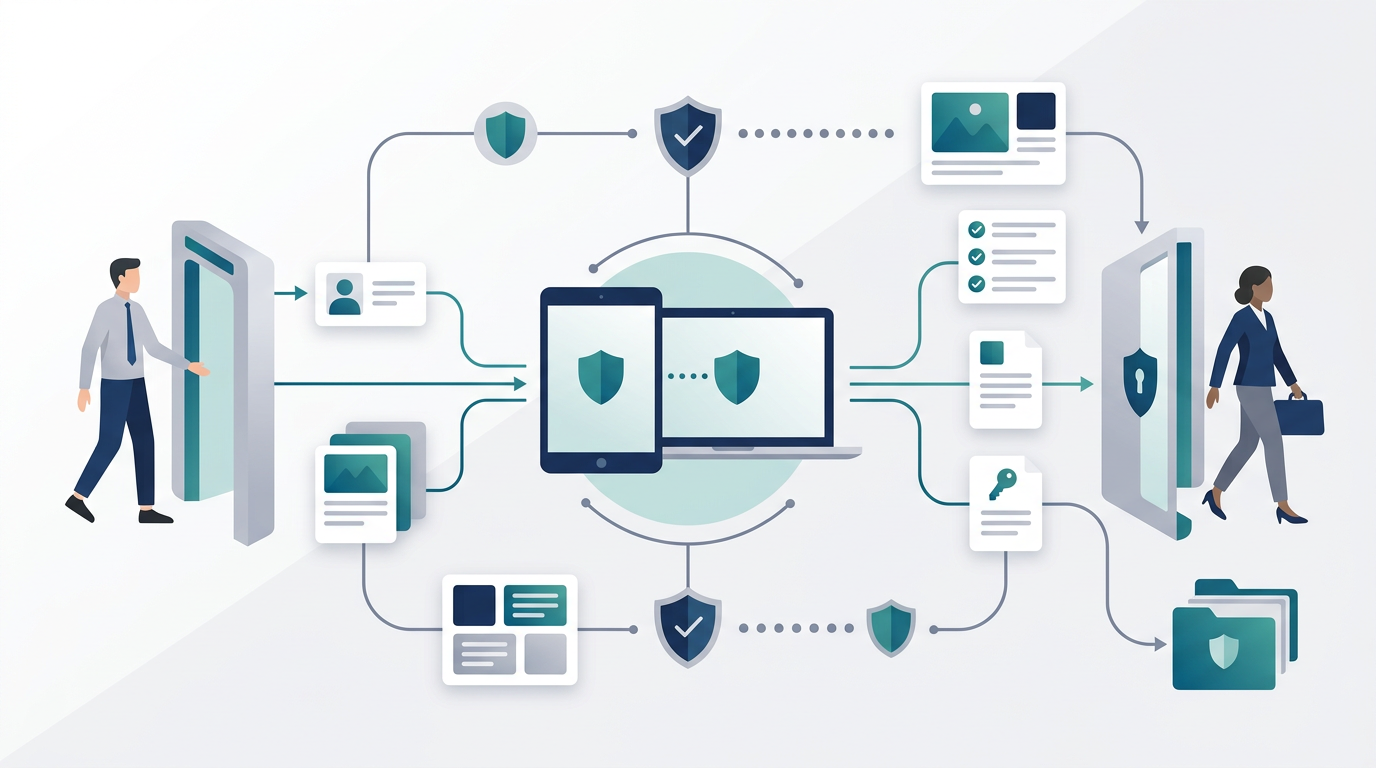
- A controlled advisor lifecycle connects identity, device access, approved content, communications capture, recordkeeping, and verified access removal.
- Firms need to preserve required records while removing access to content platforms, client-facing assets, and firm data promptly when an advisor leaves.
- A structured transition process can reduce manual work, improve advisor readiness, and give leadership clearer evidence that supervisory controls are operating as intended.
Article at a Glance
Most firms do not discover their content governance weaknesses during annual policy reviews. They discover them when an advisor resigns, when a new hire needs approved materials for a first client meeting, or when an examiner asks for records from a transition period.
An advisor joining or leaving changes the firm’s risk profile across content access, client communications, devices, records, supervision, and brand representation. The response needs to be coordinated. Disabling a network login, collecting a laptop, or sending an exit checklist does not resolve every issue tied to advisor content.
The practical challenge is organizational. HR manages the personnel event. IT provisions devices and credentials. Compliance oversees supervision and recordkeeping. Marketing manages content and approvals. Distribution needs advisors productive quickly. Branch leaders manage client continuity. When those functions work from separate checklists, gaps are predictable.
A well-governed process treats advisor transitions as a single lifecycle. It gives new advisors approved, role-appropriate content from the start. It removes departing advisors’ access at the right time. It preserves records, reviews client-facing assets, and documents completion in a form the firm can retrieve when questions arise.
Why Advisor Device Transitions Break Down
The central issue is not technology alone. It is fragmented ownership.
In many wealth management organizations, no individual or function owns the complete advisor transition lifecycle. HR initiates the personnel action. IT creates or disables accounts. Compliance monitors communications and recordkeeping. Marketing manages a content library. Distribution and branch leaders focus on field readiness and client relationships.
Each department performs legitimate work. Yet the process fails when no one verifies that the sequence is complete.
A departing advisor’s core network account may be disabled, while access to a separate content platform, cloud repository, webinar tool, social publishing platform, or co-branded landing-page system remains active. A new advisor may receive a laptop and email account but have no timely access to the approved materials needed for client conversations. In both cases, the firm has completed part of the work while missing the control that matters most.
Where Ownership Commonly Breaks Down
| Function | Primary responsibility | Common transition gap |
| HR | Start dates, end dates, employment status | Downstream systems are not notified early enough |
| IT | Devices, identity credentials, network access | Separate vendor applications and personal-device controls are missed |
| Compliance | Supervision, recordkeeping, policy interpretation | Access removal and records preservation are assumed rather than verified |
| Marketing | Content libraries, approvals, brand assets | Advisor-specific links, profiles, and co-branded materials remain active |
| Distribution | Field productivity and advisor enablement | Advisors lack ready access to approved content at the start of client-facing work |
| Branch leadership | Client handoff and team continuity | Content, communications, and client transition decisions are not documented |
The resulting delays are rarely dramatic at first. A request remains in a queue. A vendor account is overlooked. A shared content link stays live. A personal tablet is not enrolled in the firm’s mobile-device management process. The problem becomes serious when the firm must demonstrate what happened, when it happened, and whether the controls worked.
Device Offboarding Is Not Content Offboarding
IT offboarding and content offboarding overlap, but they are not the same process.
Disabling a primary credential does not necessarily remove access to every cloud-based application. Recovering a firm-issued laptop does not address content stored on a personally owned device. Removing a user from the CRM does not automatically deactivate a co-branded landing page, a shared newsletter list, a presentation link, or a third-party content account.
Content offboarding extends beyond the physical device. It includes:
- Approved-content libraries and digital asset repositories
- Advisor-specific presentation materials and co-branded documents
- Shared links, landing pages, and online profiles
- Client-facing email, social, messaging, webinar, and event platforms
- Pre-approval records, version histories, and distribution logs
- Offline files, cached materials, and locally stored firm information
- Shared devices used in branch, event, or field settings
A firm that treats departure as a narrow device-recovery event will leave too much to chance.
Distributed Networks Add Complexity
Remote work, hybrid field models, personal devices, shared branch equipment, and multiple vendor platforms make advisor transitions harder to control.
A process designed for a centralized office and firm-owned laptop does not translate automatically to an advisor who works from a personal tablet, accesses content through several cloud applications, and interacts with clients across email, video meetings, messaging, and mobile tools.
Personally owned devices create a specific constraint. The firm generally cannot erase an advisor’s personal device in full, yet it still needs an appropriate way to remove firm applications, credentials, content, and data under its policies and agreements. That is why device-management decisions need to be made before an advisor begins conducting firm business from the device.
Shared devices need their own controls. A branch tablet, conference-room workstation, or event device can retain session data, downloaded materials, or access tokens after one user leaves. Removing a departing advisor’s individual credentials is not enough if shared equipment has not been reviewed and reset.
The Risks Hidden in Content Access
Advisor transitions expose content risks that are easy to miss because they sit outside the usual focus on email accounts, badges, and firm hardware.
A departed advisor may retain a locally saved presentation, a cached client document, a content-platform login, or a live link tied to the firm’s brand. A new advisor may send material from a prior employer, a public website, or an unapproved personal folder because the approved option is not ready when they need it.
Neither outcome requires malicious intent. Both arise when the compliant path is slower or harder than the informal workaround.
Unauthorized or Stale Content
The risk is not limited to confidential information. Stale, expired, altered, unapproved, or misattributed content can create supervision and reputational concerns.
Examples include:
- Marketing materials downloaded to an unmanaged personal device
- Advisor-specific presentation decks that still contain a former advisor’s name or contact details
- Shared links that remain active after an advisor’s departure
- Co-branded materials created from firm templates without current approval records
- Content versions that have expired, changed, or been replaced in the central library
- Client communications that occurred outside approved capture and archival channels
- Content pending in a pre-approval workflow when the advisor’s employment ends
The firm must distinguish between materials that should be removed from use and records that must be retained. Those are separate obligations. A process that deletes everything indiscriminately can create a recordkeeping problem. A process that preserves everything without access controls can create a distribution and brand-control problem.
BYOD Changes the Exit Conversation
Bring-your-own-device arrangements can offer flexibility and lower hardware costs, but they require clear policy, contractual, technical, and supervisory decisions.
The core challenge is separation. A firm needs to remove business access and firm data without interfering with the advisor’s personal applications, files, and communications. That requires the firm to establish its approach before the device is used for business activity.
A mature BYOD program generally depends on defined rules for:
- Which applications and communications channels may be used for firm business
- Whether the firm requires enrollment in mobile-device management or application-management tools
- How firm data is separated from personal data
- Whether approved content can be downloaded, cached, or accessed offline
- What access removal or selective data-removal actions are permitted at separation
- How the firm handles devices that were never enrolled or properly configured
Without these decisions, offboarding depends heavily on voluntary cooperation and after-the-fact reconstruction.
Recordkeeping Does Not End at Departure
Access removal ends the advisor’s ability to use systems. It does not end the firm’s responsibility to preserve required records.
Business communications, approval records, content versions, distribution histories, and other records may need to remain accessible under the firm’s applicable retention obligations. The precise requirements depend on the firm’s registration, business model, policies, contracts, and regulatory framework.
The operational point is straightforward. Before a device is wiped, reassigned, or returned to service, the firm needs a documented process for identifying and preserving records that belong in the approved archive. Before an account is deleted, the firm needs confidence that required communications and audit data remain available.
An examiner or internal reviewer will not accept a general assurance that the records should exist. Leadership needs evidence that they were captured, retained, and retrievable.
What Good Looks Like
A well-governed advisor lifecycle begins before a new advisor’s first client interaction and continues after a departing advisor’s final day.
The goal is not to create unnecessary friction. The goal is to make controlled access routine, timely, and easier to use than informal workarounds. New advisors should receive the content, tools, permissions, and guidance appropriate to their roles. Departing advisors should lose access according to a defined timetable while the firm protects client continuity and records retention.
The process works when the same lifecycle connects:
- The personnel event
- Identity and role assignment
- Device and application configuration
- Content access and approval status
- Communications capture and supervisory records
- Access removal and device controls
- Client transition activities
- Post-transition review and documented completion
Content Classification Before Day One
Before an advisor distributes firm-related content, the firm needs a current inventory of what that advisor may access and share.
A usable content inventory does more than list files. It identifies the approval status, version, expiration date, eligible audience, distribution scope, restrictions, and responsible owner for each asset. It should distinguish between materials available to all advisors, content restricted by role or product authorization, and assets that require individual review before use.
This becomes especially important when a firm manages presentations, fact sheets, email templates, calculators, social content, market commentary, event materials, and co-branded documents across different teams and systems.
A new advisor should not enter a broad, unfiltered library and decide independently what is suitable. Their access should reflect their role, region, product permissions, team assignment, and firm policy.
Role-Based Access That Supports Productivity
Role-based access controls are not only an IT security measure. They are an operational design choice.
An advisor who sees a curated set of current, approved materials relevant to their role can begin productive work sooner. An advisor who must search through outdated folders, request access by email, or rely on materials from a prior firm is more likely to create risk and consume compliance time.
The content experience should answer practical questions quickly:
- What can I use now?
- What requires review before distribution?
- What has expired or changed?
- What is approved for my role, market, and client segment?
- Where do I find the current version?
The compliant route must be usable under real field conditions. If it takes longer to locate approved content than to use a personal file, informal workarounds will persist.
Supervision and Archival at Every Access Point
Supervision should not depend on a manual export, a monthly spreadsheet, or someone remembering which system holds the relevant record.
A connected operating model records the important events. It captures the advisor’s identity, the approved version of the material, the date and time of access or distribution, the applicable approval state, and the appropriate communications record where required.
That record supports several needs at once:
- Supervisory review
- Internal audit and control testing
- Content-version management
- Investigation of exceptions
- Client communication continuity
- Examination readiness
The objective is not surveillance for its own sake. The objective is evidence. A firm needs to show that it maintained a workable process and that the process operated during ordinary activity and personnel changes.
A Seven-Part Framework for Advisor Content Transitions
This framework gives executive teams a practical way to assess their current process. It is not a substitute for legal, compliance, cybersecurity, or supervisory guidance tailored to the firm. It is a management model for identifying ownership gaps, weak handoffs, and control points that need attention.
| Control area | Leadership question | Evidence to seek |
| 1. Governance and ownership | Who is accountable for the complete lifecycle? | Named owner, RACI, escalation path, approved process |
| 2. Identity and device provisioning | What triggers access and device configuration? | Authoritative personnel trigger, provisioning logs, device inventory |
| 3. Content permissions | What can each advisor access and distribute? | Role mappings, entitlement records, approval rules |
| 4. Approval workflow | How are approval decisions recorded and enforced? | Version history, approver records, exception logs |
| 5. Communications and records | How are required records captured and retained? | Archive confirmation, retention mapping, retrieval tests |
| 6. Exit controls | How is access removed and verified? | Deprovisioning logs, vendor-account review, device actions |
| 7. Post-transition review | What remains to be closed after access ends? | Client handoff record, asset review, completion signoff |
1. Governance and Ownership
The first decision is accountability.
A cross-functional process requires one lifecycle owner with authority to coordinate HR, IT, compliance, marketing, distribution, operations, and branch leadership. The owner does not need to perform every task. They do need to confirm that the whole process is complete.
Leadership should define:
- Who owns the end-to-end workflow
- Which team performs each control
- What event triggers onboarding and offboarding
- Which actions require compliance review
- How exceptions are approved and recorded
- Who can authorize a delay in access removal
- How senior management receives escalation when controls are incomplete
Without a clear owner, the organization has a collection of departmental responsibilities rather than a governed process.
2. Identity and Device Provisioning
A personnel action should trigger the relevant downstream work. That includes identity creation or removal, device assignment, approved application access, mobile controls, content-platform permissions, and communications capture.
For a new advisor, the objective is readiness before client-facing activity begins. The device should be configured according to firm policy. Approved applications should be available. The advisor should understand the permitted channels for content and client communication.
For a departing advisor, the process should identify every account and device associated with that advisor. This includes systems that do not rely on the firm’s primary identity provider.
A firm should be able to answer two questions without relying on verbal confirmation:
- When was access granted or removed?
- Which systems, devices, and applications were included?
3. Content Access Scoped to Role
Content permissions should reflect the advisor’s status, role, geographic coverage, business line, product authorization, and supervisory requirements.
A producing advisor, branch manager, associate advisor, wholesaler, marketing professional, and compliance reviewer do not need identical content access. Treating every user as the same creates unnecessary risk and makes the content environment harder to navigate.
The role model should also address transitions within the firm. An advisor moving to a new region, team, entity, or product scope may need revised content permissions and refreshed approvals. Prior access should not be treated as permanently valid because the individual remains employed.
4. Approval Status Must Be Explicit
Approval status should be transferred through documented processes, not assumed.
Content used at a prior firm, under a prior role, or within another affiliated entity may not align with the new firm’s policies, disclosures, supervisory arrangements, or distribution rules. Even when the underlying material appears similar, the approval record may not apply.
A defensible approval workflow records:
- The specific version of the content
- The approval decision
- The responsible reviewer
- The date and scope of approval
- Any conditions or limitations on use
- Expiration, replacement, or withdrawal status
That structure reduces the need to reconstruct approval history from email chains and local folders when questions arise later.
5. Audit Trails From the First Login
An advisor’s content audit trail should begin when access begins.
The exact level of tracking should reflect firm policy, platform capabilities, and applicable requirements. At a minimum, the firm should be able to associate content access and distribution activity with the user, approved asset version, relevant timeframe, and required supervisory record.
This supports a practical business purpose. If a manager, compliance reviewer, client, or examiner asks what content was used, the firm should not need to interview multiple departments and search old inboxes to answer.
6. Access Removal and Device Controls at Exit
Offboarding should be timely, coordinated, and verifiable.
When an advisor leaves, the firm should review:
- Core identity credentials
- Content-platform accounts
- Cloud repositories and shared drives
- CRM and marketing automation systems
- Email, messaging, webinar, social, and event platforms
- Co-branded assets and personalized digital profiles
- Mobile-device management enrollment and firm application access
- Firm-owned hardware and shared-device sessions
The standard should be defined in policy. It should not depend on how quickly one department notices the separation or whether the departing advisor remembers every system they used.
For personally owned devices, the process should follow the firm’s BYOD policy and applicable agreements. This may include removing firm-managed applications, revoking credentials, and using selective removal methods where they were established before the device was used for firm business.
7. Post-Transition Review and Records Confirmation
Access removal is not the final step.
The firm should confirm that client-facing assets tied to the advisor have been reviewed. This includes landing pages, online profiles, distribution lists, shared links, scheduled campaigns, pending approvals, and co-branded materials.
The review should also confirm that required records are preserved before devices are wiped, reassigned, or removed from the environment. A manager or branch leader may need to document client handoffs, open service issues, and pending communications.
The output should be evidence of completion, not an informal assurance that the process was handled.
Building an Operating Model That Fits the Firm
Not every firm needs the same technology stack. Every firm does need a repeatable model that matches its size, risk profile, advisor network, device policy, and supervisory structure.
The practical mistake is assuming that the only choices are a fully manual checklist or a large-scale platform replacement. Many firms can improve materially by clarifying ownership, standardizing key controls, and integrating the highest-risk systems first.
Start With the Controls That Matter Most
A firm with limited technology resources should begin by establishing a dependable baseline:
- A defined personnel event that triggers onboarding and offboarding
- One accountable lifecycle owner
- A current inventory of content platforms and client-facing systems
- Role-based content permissions where feasible
- A documented process for approval records and version control
- A defined offboarding checklist that includes third-party applications
- Records-preservation confirmation before device wipe or account deletion
- Documented review of advisor-specific assets after separation
Manual steps are not inherently inadequate. Uncontrolled, undocumented, and unverified manual steps are the problem.
Evaluate Technology as Part of the Workflow
Technology should reinforce the process, not become another disconnected tool.
When evaluating a mobile content platform or related infrastructure, leadership should ask:
- Can access be provisioned and removed by role?
- Can the platform reflect approval status and content versioning?
- Does it create usable audit records?
- Can it support offline access according to firm policy?
- Can it integrate with identity, device, CRM, archive, or help-desk workflows?
- Can the firm review and export its own data?
- Can the platform support defined retention and supervision processes?
- Does the user experience make approved content easy to find in the field?
A platform that adds friction for advisors or requires separate manual administration for every transition will recreate the same control gaps it was intended to address.
Measure Execution, Not Policy Intent
A policy can be complete on paper while the transition process fails in practice.
Leadership should review operating measures that reveal whether the workflow is functioning:
| Measure | What it reveals |
| Time from start approval to completed access provisioning | Whether new advisors are ready before client-facing activity |
| Time from separation notice to verified access removal | Whether offboarding occurs within the firm’s stated standard |
| Number of systems missed during offboarding | Gaps in the application inventory or workflow |
| Open device recovery or BYOD removal cases | Exposure that remains unresolved after departure |
| Incomplete records-preservation confirmations | Potential archive and retention weaknesses |
| First-month support volume for new advisors | Whether onboarding provides a workable environment |
| Repeated exception requests | Where policy, workflow, or technology does not match real field conditions |
These measures should be reviewed regularly by the functions responsible for the lifecycle. One unresolved case can reveal a broader design problem.
Transition Scenarios That Expose the Trade-Offs
A Growing Regional Team Without Centralized Provisioning
A regional wealth firm hires several advisors over a short period. HR completes the personnel paperwork. IT creates email accounts and issues laptops. Content access depends on a separate request to marketing, which is delayed while the team focuses on a campaign launch.
The new advisors have devices, email, and client meeting schedules. They do not have a clear source for approved materials. Some ask colleagues for old presentations. Others use documents from their prior firms.
The immediate issue is not advisor behavior. It is sequencing. The firm allowed client-facing readiness to begin before approved content access was confirmed.
The right response is to define a readiness threshold. An advisor should not be activated for client-facing work until required content permissions, communications controls, and training have been confirmed. That requirement increases discipline, but it reduces the need for later remediation.
A High-Volume Offboarding During a Restructure
A broker-dealer restructures several teams and processes multiple advisor departures in a compressed period. Core credentials are disabled on schedule, but the firm discovers later that some advisors retained access to separate vendor platforms and that several co-branded materials still contain former advisors’ contact information.
The issue is not that the firm lacked an offboarding checklist. The checklist did not include a complete system inventory or a required post-transition asset review.
A mature response assigns one lifecycle owner, establishes a current application inventory, and requires evidence of completion from every responsible team. Marketing reviews client-facing materials. Compliance confirms the records process. IT addresses identity and device controls. Branch leadership confirms client continuity.
A Small RIA With Personally Owned Devices
A small RIA allows advisors to use personal phones and tablets for approved business applications. The firm has basic policies but no consistent device enrollment process. When an advisor leaves, the firm can revoke core credentials but cannot verify what materials remain stored locally or whether client communications occurred through approved channels.
The RIA does not need enterprise-scale infrastructure to improve its position. It needs a proportionate policy, defined approved applications, a documented enrollment requirement for devices used in firm business, and a clear exit process tied to its contracts and supervisory procedures.
The trade-off is clear. Personal-device flexibility can support advisor convenience, but it reduces control unless the firm establishes reasonable boundaries before the device is used for client work.
Frequently Asked Questions
What content access should be removed immediately when an advisor leaves?
The firm should remove access to content platforms, approved-content libraries, cloud repositories, client-facing digital assets, co-branded material repositories, distribution tools, and applications used to share content with clients or prospects. This includes third-party tools with separate credentials, not only systems connected to the firm’s primary login.
Advisor-specific landing pages, links, profiles, distribution lists, and scheduled communications should also be reviewed promptly. The firm’s policy should define timing and ownership rather than leaving the decision to individual departments.
How do BYOD policies affect offboarding?
BYOD changes the available controls. A firm generally cannot perform a full wipe of a personal device, but it may need to remove firm applications, credentials, managed containers, and firm data according to its policies and agreements.
This works best when the device was enrolled in an approved management process before the advisor used it for firm business. When no such controls exist, the firm faces greater reliance on contractual obligations, user cooperation, and manual confirmation at separation.
Who should own advisor onboarding and offboarding?
One lifecycle owner should be accountable for the full process. The appropriate owner varies by firm. It may sit in operations, compliance, technology governance, or a dedicated advisor-transition function.
The critical point is accountability. HR, IT, compliance, marketing, distribution, and branch leadership all have roles, but one owner must verify that the required tasks were completed and documented.
How should firms preserve communications and content records after departure?
The firm should confirm that required communications, approval records, content versions, and distribution histories are retained in the appropriate archive before accounts are deleted or devices are wiped. The precise retention requirements depend on the firm’s registration, policies, applicable rules, and supervisory structure.
The process should also confirm that records remain retrievable after the advisor’s access ends. A preserved record that cannot be located when needed is not a reliable control.
Does a new advisor need compliance review before receiving content access?
The firm’s policies and supervisory structure determine the exact process. In a regulated environment, role assignment, product permissions, content access, and client-facing authority should be configured deliberately rather than assumed from basic employment onboarding.
Role-based controls can reduce manual effort by limiting access to content appropriate for the advisor’s status. They do not eliminate the need for the firm to confirm that the role itself, related permissions, and communications channels are correctly configured.
What should a mobile content platform support during onboarding?
A mobile content platform should help the firm provide role-based access to current approved materials, reflect content version and approval status, support the firm’s offline-access policies, produce usable activity records, and work with relevant identity, device, communications, and archival processes.
The most important test is operational. A new advisor should be able to find and use approved content without waiting for a chain of manual workarounds.
How can leadership determine whether the transition process is working?
Review execution data. Measure how long onboarding takes from approved personnel action to verified readiness. Measure how quickly access is removed after separation. Track missed systems, unresolved devices, incomplete records confirmations, exceptions, and early support demand from new advisors.
Then review individual exceptions. They reveal whether the issue is unclear ownership, incomplete policy, weak integration, inadequate training, or a platform that does not match how advisors actually work.
A More Controlled Way to Manage Advisor Change
Advisor transitions test the quality of a firm’s operating model. They reveal whether content governance, mobile access, supervision, and recordkeeping are connected or merely managed in parallel.
A sensible starting point is an internal transition review. Map every system an advisor uses to access, create, distribute, approve, archive, or manage content. Identify where ownership is unclear, where steps depend on email handoffs, and where completion cannot be verified with a record.
FMEX can help leadership teams discuss a compliance-first AI nurturing and automation assessment tailored to their technology stack, patient journey, and goals. For financial-services firms, that assessment should focus on the advisor lifecycle, content governance, communications workflows, access controls, and the operational changes needed to make approved content easier to use and easier to supervise.