
Key Takeaways
- A client communication strategy can involve several tools. Calls, texts, email, newsletters, social posts, and client portals each serve a different purpose, and one platform may not cover them all.
- The biggest gap in most practices is the stretch between meetings, when clients hear little and fill the silence with their own assumptions.
- Five questions narrow the field quickly: channel coverage, CRM fit, advisor branding, and how the platform supports compliance review.
- A steady rhythm the team can sustain usually does more for client trust than a long feature list nobody has time to use.
- For practices that need help with regular educational outreach, a content platform can support the one-to-many side of client communication without replacing tools used for personal conversations.
Article at a Glance
Most advisory practices do not lack ways to reach clients. They lack a steady, useful flow of communication between meetings, and no single tool solves it.
Look at how communication actually happens in a typical practice. An advisor texts a client from a phone, emails a PDF after a review, posts on LinkedIn when time allows, and sends a newsletter when someone remembers. Each tool does its job. Together they leave clients with long stretches of silence, broken up by messages that arrive without a pattern.
Choosing a client communication platform for financial advisors starts with deciding which part of the relationship the platform needs to carry. Some tools focus on one-to-one conversation: calls, texts, and secure messages. Others focus on one-to-many communication, such as market commentary, educational articles, and newsletters that keep many clients informed without a personal note every time. Most practices need both layers, and few products cover both well.
A good choice reduces effort for the advisor and adds clarity for the client. A poor one adds another login and another thing to forget.
The sections below cover what a platform should handle, five questions worth asking before committing, and where content-led communication fits.
The Silence Between Meetings Is the Real Problem
Advisors do a lot of work that clients never see. Portfolios are monitored, tax situations are reviewed, and plans are adjusted quietly. When nothing needs action, nothing gets said.
Clients tend to fill that silence themselves. A market drop, a headline about inflation, or a conversation at a family dinner raises a question. If the advisor has not spoken first, the client hears from the news instead.
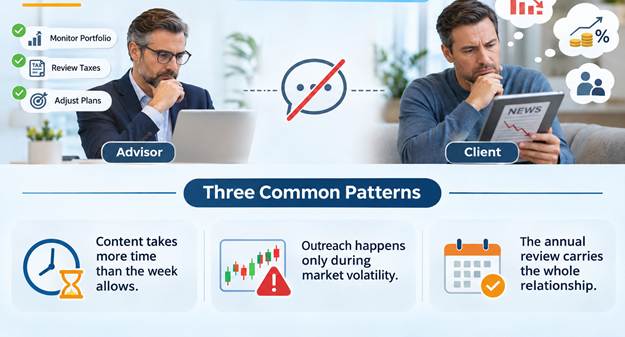
Three patterns show up often:
- Advisors go quiet because creating good content takes more time than the week allows.
- Outreach happens only when markets turn volatile, which makes every message feel like bad news.
- The annual review carries the whole relationship.
None of this comes from a lack of care. It comes from a lack of system. Communication that depends on someone’s memory and spare hours will always be uneven.
What a Client Communication Platform Should Cover
The table below describes the capabilities an advisory practice may need across its communication setup. It does not mean every platform provides every capability.
| Communication need | What it looks like | Why it matters |
| One-to-one conversation | Calls, texts, secure messages | Handles personal questions and time-sensitive issues |
| One-to-many education | Newsletters, articles, market commentary | Keeps clients informed between meetings |
| Public presence | LinkedIn, Facebook, and X posts | Builds visibility with prospects and referral sources |
| Records and review | Approval trail, archiving, retrieval | Supports supervision and recordkeeping |
| Workflow | CRM sync, scheduled delivery | Keeps communication connected to the client record |
A practice may use separate tools for personal conversations, content distribution, and client records. The important question is whether those tools work together and whether the firm can retrieve the records it needs.
Records deserve attention early. Electronic communications can create recordkeeping obligations, such as Exchange Act Rules 17a-3 and 17a-4 for broker-dealers and Advisers Act Rule 204-2 for registered investment advisers. Content shared with clients and prospects may also fall under advertising rules, including the SEC Marketing Rule and FINRA Rule 2210.
These rules do not apply identically to every advisor or every message. What applies depends on the firm’s registration, business model, communication type, audience, and jurisdiction. A platform can support recordkeeping and review processes, but it does not replace the firm’s supervisory procedures, compliance professionals, or legal counsel.
Five Questions to Ask Before Choosing a Client Communication Platform for Financial Advisors
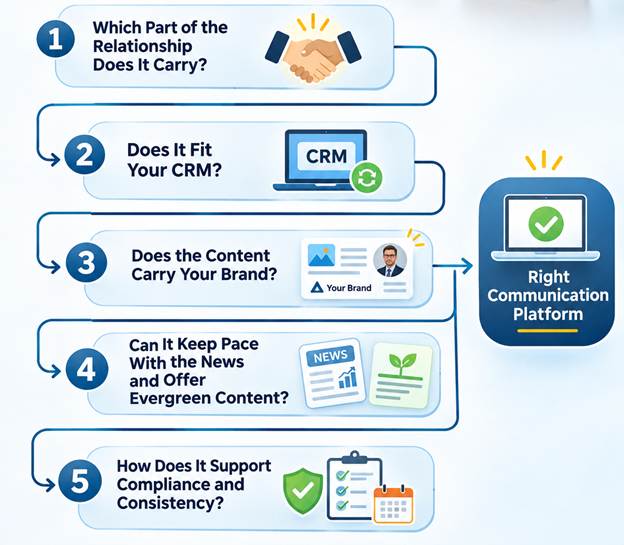
1. Which Part of the Relationship Does It Carry?
Start by naming the gap. A texting tool does not supply content, and a content library does not replace a phone call. Comparing features before naming the gap is how practices end up with three tools that overlap and one need that stays unmet.
List the communication tasks that take the most time or are most likely to be missed. Then decide whether the practice needs better one-to-one communication, more consistent educational outreach, or a combination of both.
2. Does It Fit the CRM the Practice Already Uses?
Communication that lives outside the CRM disappears from the client record. Check whether the platform connects with the CRM the team relies on, and what flows back: who received what, and when. Without that trail, no one can tell which clients have heard from the practice recently.
Also check which activities are recorded. A platform may track content distribution without capturing phone calls, text messages, or conversations handled through other tools. Confirm that the records it provides meet the firm’s operational and compliance needs.
3. Does the Content Carry the Advisor’s Brand?
Clients hire an advisor, not a platform. Look for controls that put the advisor’s name, logo, and photo on every piece, so the content reads as part of the practice’s own communication. Generic, platform-branded material points clients toward the platform instead of back to the advisor.
Check whether branding can be applied consistently across newsletters, articles, and other available content formats. The aim is to make educational communication recognizable as part of the advisor’s practice, without assuming every format can be customized in the same way.
4. Can It Keep Pace With the News and Still Offer Evergreen Planning Content?
Two kinds of content matter. Timely commentary helps when markets move or a headline raises questions. Evergreen pieces on retirement, tax, and estate planning carry the steady educational load. A platform that offers only one leaves a gap. Ask who writes the material, how quickly new pieces arrive, and whether financial professionals review them.
5. How Does It Support Compliance and Consistency?
Ask what the compliance team will be able to see: approval history, access permissions, archiving, and retrieval. Ask whether delivery can run on a schedule, so the rhythm does not depend on one person remembering. Bring compliance into the evaluation before rollout, not after.
Do not assume that a content provider’s review process automatically satisfies the firm’s compliance obligations. The firm should confirm how each type of communication is reviewed, approved, distributed, and retained.
Mistakes That Quietly Undermine Adoption
Even a good platform fails if the team does not use it.
Four causes come up again and again:
- Buying on feature count. A long list of capabilities rarely maps to the two or three jobs the practice needs done.
- Choosing without the people who will use it. Advisors and assistants know exactly where the current process breaks.
- Setting a schedule the team cannot sustain. Weekly emails that stop after a month send a worse signal than a quarterly note that never misses.
- Counting sends instead of use. Opens, replies, and client conversations that begin with a shared piece say more than volume does.
Where Content-Led Communication Fits
For many practices, the one-to-many layer is the thinnest. Advisors know they should send market perspective, planning reminders, and educational articles. Few have the hours to write them.
A content-as-a-service model closes that gap. An editorial team produces and updates the material, and the advisor adds a personal brand and sends it. The advisor keeps the role of trusted voice, and the platform does the production work.
This is where FMeX fits into the broader communication setup. Its offering focuses on financial content and client engagement, including timely market insights, weekly commentaries, evergreen planning material, customizable communications, and automated content distribution. Advisors can add their logo and headshot to help make the content recognizable as part of their practice.
FMeX also lists CRM integrations, including Salesforce, Redtail, Wealthbox, and SmartOffice. Practices can assess how these integrations and content tools fit alongside their existing systems for direct client conversations and other communication needs.
A practical test: after the next market event, how long would it take the practice to get a client-ready message out? If the answer is days, the gap is worth fixing. If the answer is the same afternoon, the system is working.
Frequently Asked Questions
What Should a Client Communication Platform for Financial Advisors Include?
At a minimum: channels that match how clients prefer to hear from the advisor, CRM integration, branding controls, a steady supply of reviewed content, and records that supervisors can retrieve. Which of these matters most depends on whether the practice’s gap is conversation, content, or both.
Can One Platform Replace Texting, Email, and the Client Portal?
Usually not, and it does not have to. The better question is whether the tools in use work together and share records, so nothing about a client relationship sits in only one place.
How Often Should Advisors Communicate With Clients Between Meetings?
There is no universal number. The right rhythm depends on the client’s preferences and the practice’s service model, so asking clients how often they want to hear from the advisor is a sound starting point.
Does a Content Platform Replace Compliance Review?
No. A platform can organize workflow, preserve records, and make review more consistent. It does not replace compliance professionals, supervisory procedures, or legal counsel.
Start With the Gap
A practical first step is a simple inventory. List every way the practice reaches clients today, mark each as one-to-one or one-to-many, and note where the records live. The thinnest layer is usually obvious once it is on paper. Fix that first, involve compliance early, and add tools only when a gap justifies them.
For practices weighing a client communication platform for financial advisors, Financial Media Exchange can help assess where content and engagement fit alongside existing tools. Our editorial team works within the 72-hour news cycle, publishes weekly market insights and commentaries, and maintains a library of evergreen financial planning content.
Advisors can add their logo and headshot, use customizable communications and automated content delivery, and connect with supported CRM systems, including Salesforce, Redtail, Wealthbox, and SmartOffice.