
Key Takeaways for Compliance Success
- Properly blending licensed content with proprietary materials requires a centralized governance system that clearly displays usage rights, expiration dates, and attribution requirements.
- Financial firms face heightened regulatory scrutiny, with potential penalties ranging from substantial fines to license restrictions or even loss when content compliance fails.
- A robust content inventory that maps exactly what you own versus what you license creates the foundation for compliant, scalable content operations.
- Implementing clear visual signals for content license status (approved, restricted, expired) helps prevent unintentional compliance violations by advisors and marketing teams.
- Adopting a governance‑first content strategy delivers operational efficiency while functioning as an insurance policy against regulatory and copyright action.
Article at a Glance
The wealth management and financial advisory industry runs on content. Market commentaries, investment outlooks, product explanations, portfolio reviews, and client communications are now core infrastructure for growth—and a growing source of regulatory and copyright exposure. As firms license more third‑party materials and combine them with proprietary analysis, informal workflows and scattered repositories turn everyday content production into a persistent compliance risk.
Content failures in this environment rarely come from overt misconduct. They emerge from system gaps: fragmented storage, unclear licensing, ad hoc reuse, and manual tracking that collapses under scrutiny. When advisors or marketers blend licensed content with internal files without clear rules, the result can be regulatory penalties, copyright claims, brand damage, and urgent remediation projects that drain leadership attention.
This article lays out a governance‑first approach to blending licensed and original content. It covers the structural problems that drive risk, what a modern compliant content ecosystem looks like, a practical governance framework, the role of technology, and real‑world scenarios from firms that have made the shift. The goal is to give executives a realistic, system‑level playbook they can use to protect the firm while enabling advisors to communicate more confidently and consistently.
The High‑Stakes Reality of Blending Licensed and Original Content
For wealth management and financial advisory firms, content is both essential fuel for growth and a persistent source of risk. Every market commentary, investment outlook, and client education piece you distribute carries regulatory and copyright implications that must be managed deliberately. The stakes rise when teams blend licensed third‑party content with proprietary materials across web, email, social, print, and in‑person channels.
Real Financial Consequences of Non‑Compliant Content Use
The costs of improper content blending extend far beyond theoretical risk. Regulatory fines for inadequate supervision of communications routinely reach into six and seven figures, and recent enforcement trends show sustained focus on digital and advisor communications. Copyright infringement claims from content providers can seek statutory damages per work, plus legal fees and settlements.
Beyond direct penalties, firms absorb hidden costs: extended exams and audits, emergency legal consultations, crisis communications, and rushed technology deployments meant to close gaps after an issue surfaces. These remediation efforts divert leadership attention from growth initiatives and undermine internal confidence in the firm’s controls.
Why Size Doesn’t Protect You
Many smaller firms and independent practices still assume that content compliance is mainly a big‑firm issue. In practice, smaller organizations often carry higher relative risk because they lack centralized systems, standardized policies, and dedicated supervision capacity. When a small team casually copies licensed commentary into a newsletter, alters research language, or continues using content after a license term ends, they create the same legal exposure as a large institution—without the infrastructure to detect and correct the problem early.
A Stricter Regulatory Environment
Regulators have modernized their expectations around advertising, social media, and third‑party content, broadening what counts as advertising and tightening supervision, recordkeeping, and disclosure obligations. At the same time, content providers are more assertive in enforcing licensing terms, particularly as digital distribution makes unauthorized reuse easier to detect. The clear signal: both regulators and licensors expect firms to have formal, auditable governance for how licensed and proprietary content are combined and distributed.
Where the Real Risk Lives: Structural Problems in Your Content Ecosystem
Content compliance failures usually stem from structural weaknesses, not individual bad actors. The patterns tend to look similar across firms, regardless of size.
Scattered Content Sources Create Blind Spots
Most organizations maintain multiple repositories: marketing drives, compliance‑approved libraries, advisor‑specific folders, vendor portals, and personal storage. Licensed research, internal commentary, presentations, and templates live in different places with inconsistent labels and no unified view of rights. When an advisor assembles a client deck from several sources, no one system can show whether every component is within its license terms, up to date, and properly attributed.
Team Silos That Amplify Compliance Risk
Traditional separation between marketing, compliance, legal, IT, and field teams creates dangerous gaps. Marketing secures licenses and templates, compliance reviews content in isolation, and advisors adapt materials for real‑world client conversations. Without shared visibility into license terms and usage rules, critical context gets lost: advisors may not see restrictions, compliance may not see how content is actually used, and IT may not know which systems need to enforce which boundaries.
The “Just This Once” Exception That Becomes Normal
Under deadline pressure, teams rationalize exceptions: reusing commentary after expiry “because it’s still accurate,” trimming disclosures for space, or copying a chart into a different context “just this once.” These workarounds quickly become informal norms. Over time, a pattern of small deviations accumulates into systemic non‑compliance that remains invisible until a regulator, plaintiff, or content supplier challenges it.
Outdated Tracking Systems Under Examiner Pressure
Many firms still rely on spreadsheets, email trails, and manual logs to track rights, expirations, and usage. These methods might feel manageable in steady state, but they break under regulatory examination or when content volume spikes. When asked to produce a multi‑year history of how a specific licensed piece was used across advisors, channels, and jurisdictions, most manual systems cannot respond quickly or completely. That gap is itself a finding.
Getting Clear on What You Actually Own (and Don’t)
Effective governance starts with a clear, shared understanding of which content you truly own and which you hold under specific licensing conditions. Ambiguity here is the root of many downstream issues.
Four Common License Types and Their Boundaries
Most licensed content in financial services falls into a few practical categories, each with distinct implications:
- Limited‑term licenses: Rights for a defined period, after which the content must be removed from use and archives or handled per contract terms.
- Channel‑ or audience‑restricted licenses: Rights only for specified channels (e.g., email, print, portal) or segments (e.g., advisors vs. end clients).
- Modification‑limited licenses: Distribution is allowed, but changes to analysis, charts, or required language are restricted.
- “Enterprise” licenses with nuanced limits: Appear broad but still contain boundaries on redistribution, co‑branding, or number and type of users.
Assuming that “we paid for it, so we can use it anywhere” is one of the fastest paths to non‑compliance.
The Reality of “Fair Use” for Financial Firms
Internal teams often overestimate how much “fair use” protects their marketing activity. In commercial, client‑facing financial communications, fair‑use defenses are narrow and fact‑specific. Reusing large portions of articles, analysis, or unique charts—especially when tied to your services—rarely qualifies. Attribution alone does not cure unauthorized use. A safer posture is to treat fair use as an exception requiring legal review, not as a default operating model.
Geographic Restrictions and Cross‑Border Distribution
Digital distribution crosses borders by default; license rights often do not. Many agreements specify territories where content may be displayed or shared. When advisors in other regions access centrally stored content and share it with local clients, they can unintentionally breach geographic restrictions if systems do not enforce those boundaries. For multinational networks, this is a core governance and technology design issue, not a training footnote.
Digital vs. Print Rights—and Multi‑Channel Drift
Legacy contracts often distinguish between print and digital rights, or omit newer channels such as portals, webinars, and social platforms altogether. Problems arise when teams repurpose content across formats—turning a print‑licensed piece into a web article, or lifting digital content into printed reports—without checking whether cross‑channel use is covered. Over years, these small shifts create complex patterns of usage that exceed original agreements.
What “Good” Looks Like: A Modern, Compliant Content Blending Environment
Leading firms do more than avoid obvious mistakes. They design content ecosystems where the easiest way to work is also the compliant way to work.
A Single Source of Truth for All Content Assets
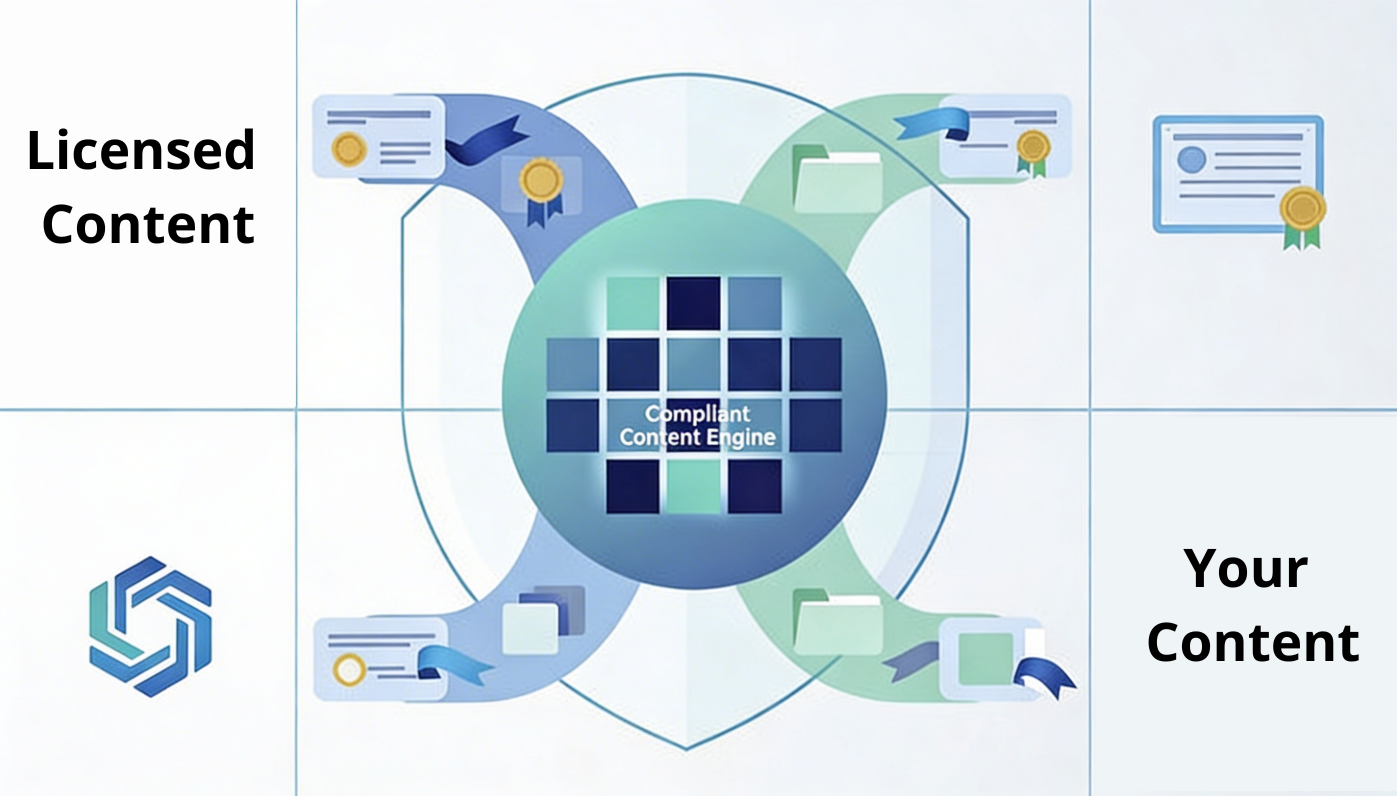
The foundation is a unified, governed repository that houses both proprietary and licensed materials under common rules. Advisors, marketers, and compliance teams access the same environment for market commentary, presentations, templates, and disclosures. Rights metadata—license type, territories, allowed channels, modification rules, and expiry—is stored with the asset and visible at the point of use. This reduces the need to hunt across drives and vendor sites and eliminates guesswork about what can be used where.
Clear Visual Signals for License and Compliance Status
In high‑performing systems, every content item carries intuitive visual cues: color codes, icons, or short labels indicating whether it is proprietary, licensed with restrictions, nearing expiry, or retired. Advisors do not need to interpret contract clauses on the fly; they see at a glance whether an item is safe to use, where, and how. This makes compliance feel like guardrails, not a separate manual lookup step.
Automated Expiry Management and Archiving
Expiration is one of the most common failure points. Modern platforms monitor license dates, notify content owners in advance, and automatically restrict or archive assets at end of term while preserving audit history. Some systems also suggest replacements or successor content when heavily used assets approach expiry, helping advisors maintain consistent client communication without interruption.
The Content Blending Governance Framework
Sustainable compliance requires a framework that spans the entire lifecycle—from acquisition through retirement—rather than a collection of point fixes. A practical way to structure this is as a five‑step governance model.
Step 1: Map Your Content Inventory and Rights
Begin with a firm‑wide inventory of content sources and assets in active use: internal libraries, vendor feeds, advisor‑created materials, and any third‑party content embedded in templates or presentations. For each licensed source, capture key terms: duration, channels, audiences, territories, modification rights, required attributions, and any special conditions.
This exercise often reveals surprises: expired licenses still in circulation, attributions regularly omitted, or usage patterns that exceed contracted scope. It also clarifies how much content is truly proprietary versus dependent on external rights.
Step 2: Translate Rights into Clear Usage Policies
Convert contractual language into practical, scenario‑based rules that non‑lawyers can follow. For example:
- “This research can be sent to clients as‑is and used in presentations, but may not be excerpted or edited.”
- “These articles may be posted on the website with the required byline and footnote until the stated expiry date.”
Effective policies anticipate everyday questions—social media reuse, combining multiple sources in one piece, translation, and re‑branding—and answer them in plain language.
Step 3: Design Approval Workflows That Scale
Define risk‑based approval paths rather than routing everything through the same bottleneck.
- Assign approvers based on content type, complexity, and licensing sensitivity.
- Set clear service‑level expectations so advisors and marketers can plan.
- Create streamlined workflows for recurring, template‑based content and higher‑touch flows for bespoke pieces.
- Document escalation routes when license questions arise, so teams do not improvise under pressure.
Safe‑harbor templates—pre‑approved and properly licensed for specific uses—can dramatically reduce review burden and advisor uncertainty.
Step 4: Build Systems to Enforce, Not Just Document, Policies
Technology should enforce policies wherever possible. Configure your content platform so that:
- Only users in permitted regions and roles can see certain licensed content.
- Assets nearing expiry are flagged at the point of use.
- Required attributions and disclosures are locked or automatically appended.
- Retired items cannot be added to new communications.
Automation here reduces human error and eases the burden on compliance teams who would otherwise rely on manual checks.
Step 5: Monitor, Audit, and Improve
Governance is not static. Establish periodic reviews of both licenses and actual usage:
- Audit a sample of communications across channels to confirm proper attribution and adherence to rights.
- Review platform analytics to identify unexpected usage patterns or regions.
- Revisit licenses as channels and strategies evolve, ensuring terms match how you now operate.
Each audit should feed back into improved training, workflows, and system configuration rather than sitting as a one‑time exercise.
Technology Enablers for Safe Content Blending
The complexity and volume of modern content operations make technology indispensable. Generic file‑sharing tools cannot provide the level of governance regulators and licensors increasingly expect.
Must‑Have Features in Content Management Systems
When evaluating or upgrading content platforms, leaders should look for capabilities tailored to licensed content governance:
- Rights and license metadata attached to each asset and visible at the point of use.
- Dynamic license tracking, including automated expiry alerts and status changes.
- Role‑, region‑, and channel‑based access controls.
- Strong version control, so advisors always pull the latest approved content.
- Immutable audit trails showing who accessed, modified, and distributed each piece.
Without these, content usage inevitably outpaces what can be supervised manually.
Automatic Usage History and Audit Trails
Systems that automatically record access and distribution history are invaluable when responding to regulator questions or license challenges. They can show which advisors used a particular asset, in what context, and over what period—without requiring separate reporting steps from users. This embedded documentation is far more reliable than after‑the‑fact reconstructions based on emails and local files.
Integrating Legal, Compliance, and Marketing Tech
The content platform cannot exist in isolation. It needs to integrate with:
- Compliance review tools, so approvals and conditions are stored with assets.
- Marketing automation systems, so only approved, in‑term content flows into campaigns.
- Archival and supervision platforms, so records are retained and searchable in line with regulatory expectations.
Increasingly, firms are also exploring AI‑assisted classification and risk scoring to flag content that may require higher‑touch review, and to detect patterns that merit policy updates.
Leadership Scenarios: Applying Compliant Blending in the Real World
Abstract models become more tangible when viewed through real‑world situations. The following composite scenarios reflect common journeys.
Scenario 1: Consolidating Multiple Content Vendors
A mid‑sized advisory firm discovered significant overlap across several content providers and inconsistent use of each vendor’s materials. Compliance lacked a consolidated view of rights; advisors were unsure which content was preferred, current, or safest to use.
The firm undertook a three‑phase effort:
- Inventory and analysis: Mapping all licensed sources, terms, and utilization, which revealed substantial duplication and underused contracts.
- Vendor rationalization: Consolidating to a smaller set of strategically aligned providers with clearer, modern terms across digital channels.
- Platform implementation: Standing up a unified content environment where all licensed and proprietary content lived under consistent governance.
The outcome: better advisor experience, reduced licensing spend, and much clearer supervisory oversight. Just as importantly, leadership gained a more accurate picture of how content influences engagement and growth.
Scenario 2: Creating Your First Governance Model
A fast‑growing independent firm scaling from a handful of advisors to several dozen realized that informal practices no longer worked. Advisors sourced content independently, reused vendor pieces in bespoke ways, and saved edited versions locally.
Leadership launched a governance initiative centered on:
- Documenting the current state through interviews and system reviews.
- Defining simple content categories (e.g., unrestricted, attribution‑required, limited‑use, restricted) with matching visual indicators.
- Establishing a centralized approval workflow and assigning a content coordinator to manage day‑to‑day governance.
- Training advisors on how the new model actually made their work easier and safer, rather than presenting it purely as a constraint.
Within months, the firm had fewer ad hoc exceptions, faster turnaround on content requests, and more confidence heading into exams.
Scenario 3: Refreshing Outdated Licenses and Policies
A regional wealth firm with decades‑old licensing relationships discovered that many agreements pre‑dated modern digital channels. Terms focused on print and direct mail, with little clarity on web, portals, or social media.
The firm responded by:
- Auditing all active content licenses against current and planned use cases.
- Prioritizing renegotiation of high‑impact relationships to secure multi‑channel, multi‑region rights aligned with how advisors now operate.
- Introducing a recurring license review cycle to keep pace with channel and regulatory changes.
This work reduced the risk of silent drift—content gradually being used in ways never contemplated in original contracts—and gave leadership confidence that long‑standing relationships were fit for a digital, multi‑channel world.
Frequently Asked Questions from Content and Compliance Leaders
As firms mature their content governance, the same leadership‑level questions tend to surface.
How much can we modify licensed content before it becomes a problem?
It depends on the specific license. In practice, factual information may sometimes be summarized or rephrased, while unique analysis, charts, and proprietary frameworks often must remain intact or be used only with explicit attribution. Many licenses differentiate among “no modifications,” limited modifications, format‑only changes, and derivative works with attribution. When in doubt, treat modification rights as narrow and seek clarification rather than assuming flexibility.
What’s the difference between attribution and citation in this context?
Attribution is what your contract requires: specific language, logos, or placement conditions that recognize the content provider. Citation is a broader concept drawn from academic and journalistic practice. In financial content, contractual attribution requirements take priority; they often specify exact wording and where it must appear. Failing to follow those conditions can breach your license, even if the source is generally identifiable.
Do we need to track internal content reuse as rigorously as licensed content?
Purely internal content that does not incorporate third‑party material typically carries fewer copyright constraints, but tracking it still matters for supervision, recordkeeping, and version control. A unified system for both proprietary and licensed content makes it easier to spot where internal materials incorporate external elements and ensures those dependencies are handled correctly.
What should we do if we discover non‑compliant content in use?
Act quickly and systematically:
- Restrict access and stop further distribution of the content.
- Document where and how it has been used, for how long, and what terms may have been breached.
- Consult legal and compliance to determine remediation steps, disclosure obligations, or notifications to licensors.
- Conduct a root‑cause analysis and update workflows, training, or system controls so the same pattern does not recur.
Treating the incident as a learning opportunity for the entire organization reduces repeat exposure.
How often should we audit our content licenses?
At minimum, conduct an annual review, with more frequent checks for high‑usage sources or periods of significant change. Many firms now review key licenses quarterly to monitor expirations, confirm usage remains within bounds, and test a sample of communications for correct attribution and channel compliance. Over time, these audits evolve from a compliance exercise into an input for renegotiating terms and optimizing the content mix.
How can leadership quickly assess whether current tools support adequate license governance?
Leaders can ask a few simple questions:
- Can we see, in one place, which assets are licensed, under what terms, and for how long?
- Can we prevent expired or restricted content from being used in new communications?
- Can we produce a usage history for a given licensed piece across advisors and channels?
- Can we adjust access or rules centrally when license terms change?
If the answer to any of these is “no” or “not without a lot of manual work,” there is likely a governance and tooling gap.
Leading with a Governance‑First Content Strategy
Firms that treat content governance as foundational—not as an afterthought—gain more than risk reduction. They create an environment where advisors communicate more frequently and confidently, marketing operates with clearer guardrails, and leadership has defensible answers when regulators and licensors ask hard questions.
A governance‑first approach means:
- Prioritizing compliance infrastructure and inventory clarity before expanding content sources or channels.
- Designing governance models that can flex as the firm grows, adds regions, or adopts new digital formats.
- Embedding checkpoints into every stage of the content lifecycle instead of relying on a single, late‑stage review.
- Aligning ownership for content governance across marketing, compliance, legal, IT, and distribution so accountability is shared rather than orphaned.
- Reporting on compliance metrics—such as error rates, review cycle times, and license utilization—alongside engagement and revenue outcomes.
For many organizations, the most important shift is cultural: positioning content governance as a way to protect clients, advisors, and the brand rather than as a constraint on creativity. When advisors see that robust governance gives them more freedom to communicate without constant second‑guessing, adoption follows.
Practical Next Steps for Leaders
Executives who want to move toward a governance‑first model can start with a focused set of internal actions:
- Map your current content vendors, internal libraries, and key usage scenarios. Identify where advisors or marketers are most likely to blend licensed and proprietary content today.
- Review your approval and distribution workflows to pinpoint where compliance checks are informal, late, or entirely manual.
- Assess your primary content and marketing systems against the must‑have governance capabilities outlined above, noting where license, attribution, and expiry controls are missing or fragmented.
From there, consider engaging a partner that specializes in compliant content infrastructure for financial services. FMEX was built to help regulated firms centralize licensed and proprietary content, embed governance into everyday workflows, and give advisors a compliant library they can trust.
If you want an outside perspective on where your current approach is strong, where it is exposed, and how to modernize it, request a compliance‑ready content governance and platform evaluation with the FMEX team. Together, you can review your existing stack, advisor workflows, and supervision obligations, then explore how a governance‑first content platform can support safer growth, more consistent communication, and better use of both licensed and proprietary content across your firm.