
Key Takeaways
- Clients judge the relationship by what they hear between meetings, not only by what happens in the room.
- A simple schedule of planned, event-driven, and personal touchpoints covers most needs without overloading the team.
- Relevance beats volume. One useful note a month usually does more than a weekly email nobody opens.
- Consistency is mostly a content and workflow problem, and both can be solved with planning and the right support.
Article at a Glance
A strong annual review can leave clients feeling looked after for a few weeks. The problem begins in the months that follow, when the advisor goes quiet.
Behind the scenes, plenty is happening. Portfolios are monitored, tax rules are tracked, and plans are adjusted. Clients simply cannot see any of it. Quiet reads as distance, and distance is what makes a client start wondering whether another advisor would pay closer attention.
Strong advisor client communication fixes that by making the work visible and the relationship feel current. It does not require daily emails or a marketing department. It requires a consistent approach that fits the client, a steady supply of useful content, and a way to keep both going when the calendar fills up.
The steps below show how to establish that approach, which touchpoints to use, and how to keep it consistent.
Why the Gap Between Meetings Matters
Many advisors meet clients once or twice a year for a formal review. That leaves most of the calendar to a relationship that runs on very little.
Clients use those months to form opinions. A market dip arrives, a friend mentions a different advisor’s approach, a news story raises a worry. Each one becomes a small question. Questions that go unanswered tend to turn into doubt, and doubt rarely announces itself. It shows up as slower replies, a rescheduled meeting, or eventually a quiet transfer of assets.
The reverse is also true. A client who receives a clear, timely note before the worry sets in often never needs to ask. That is the real job of regular check-ins: answering the question before it becomes one.
What Clients Tend to Want Between Meetings
Preferences vary, but a few themes come up consistently.
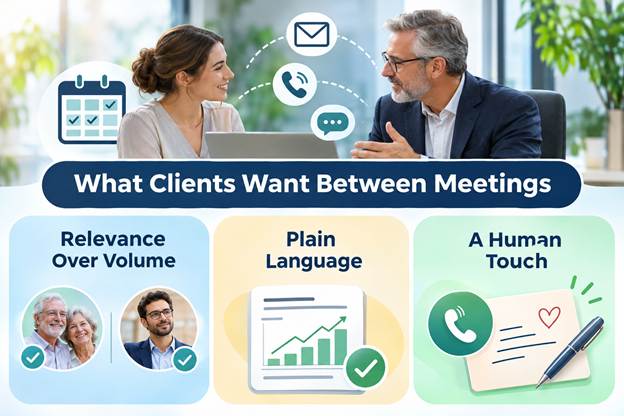
Relevance Over Volume
A retired couple and a 35-year-old business owner do not need the same message. Segmenting even loosely, by life stage or topic, makes each note feel chosen rather than broadcast.
Plain Language
Clear explanations of what happened in the markets and what it means for the plan travel further than polished jargon. If a sentence needs a glossary, it needs a rewrite.
A Human Touch
A short call after a life change, or a note that mentions something personal, tells a client they are known. Automation can carry the routine messages so that time is left for these moments.
A Simple Schedule for Advisor Client Communication
The easiest way to stay consistent is to stop treating every message as a separate decision. A layered approach gives each type of contact a purpose and a frequency.
Three Layers of Touchpoints
Scheduled Touchpoints
These are the predictable ones: a monthly newsletter, a quarterly market summary, and reminders tied to the planning calendar, such as contribution deadlines, tax season, and year-end giving. They build the baseline.
Event-Driven Touchpoints
Some moments call for a message that was not on the calendar: sharp market moves, major policy changes, or news that touches a client’s situation. A short, calm note that explains what is happening and what the advisor is watching usually lands better than saying nothing.
Personal Touchpoints
Birthdays, retirements, a child leaving for college, a thank-you after a referral. These are small and hard to scale, which is exactly why they stand out.
Match the Channel to the Client
Email works for most routine updates. Phone calls suit sensitive topics. Text can be useful, but only through channels the firm has approved and can archive. The simplest way to avoid guessing is to ask at onboarding how often a client wants to hear from the practice and in what format, then record the answer in the CRM, so the whole team follows it. Consistent advisor client communication usually starts with that one question.
Put It on a Calendar
Anchor the year to fixed moments: tax season, a mid-year check-in, retirement contribution deadlines, and year-end planning. Fill the gaps with a recurring slot for market commentary. A calendar turns “we should reach out” into “this goes out Thursday.”
Missteps That Make Clients Tune Out
Four habits cause most of the damage:
- Reaching out only when markets fall, which teaches clients to associate a message with trouble.
- Sending the same note to every household.
- Letting the schedule lapse after a busy quarter and never restarting it.
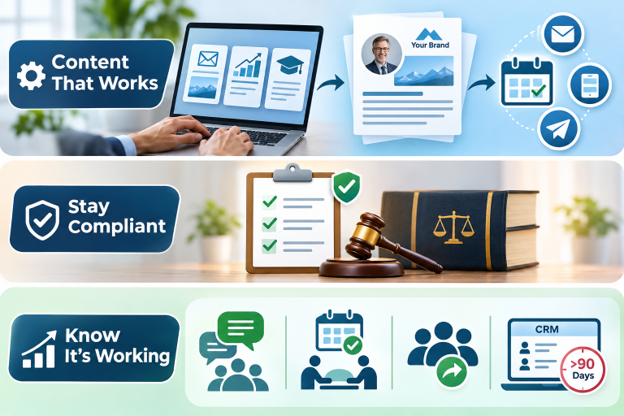
- Treating compliance review as an afterthought instead of part of the workflow.
Where Content Does the Heavy Lifting
This is where most plans stall. The pattern is easy to draw and hard to feed. Writing a monthly newsletter, a market note, and a handful of educational posts takes hours that client work keeps claiming.
That is why many practices turn to a content-as-a-service approach: a team of editors produces timely, client-ready material, and the advisor decides what goes to whom. The advisor’s brand stays front and center, with a logo, a photo, and a voice clients recognize, so every piece still reads as coming from the person they hired and not from a platform.
Automated delivery fills in the rest. Once a schedule is set, content can go out on time even in a busy week, and customizable communications let advisors tailor what goes out.
How to Tell If It Is Working
Skip vanity numbers. Better signals include whether clients reply, whether meetings are easier to schedule, whether referrals mention something the advisor sent, and how many clients have gone more than 90 days without any contact. A CRM can surface that last one in minutes. Treat all of these as directional. Many factors influence retention, and communication is only one of them.
Frequently Asked Questions
How Often Should Financial Advisors Contact Clients Between Meetings?
No single answer fits every client. A monthly or quarterly schedule works for many, with extra contact during volatile periods or life events. Asking clients about their preference is more reliable than guessing.
What Does Good Advisor Client Communication Look Like?
It is timely, clear, relevant to the client, and consistent. Clients know what to expect, when to expect it, and how to reach the advisor with questions.
How Can a Busy Advisor Stay Consistent?
Plan the year in advance, use a reliable source of client-ready content, and automate delivery for the routine pieces. Reserve personal time for the moments that need it.
Do Client Newsletters and Emails Need Compliance Review?
In most regulated firms, yes. The firm’s policies decide how review works, so advisors should follow those procedures and not assume pre-written content is cleared for every use.
Start Small, Then Stay Steady
A first step does not need new software or a bigger calendar. Pull a client list, note the last time each household heard from the practice, and pick one recurring touchpoint to add: a monthly note, a quarterly market summary, or a standing check-in call for top-tier clients. Run it for a quarter, then adjust.
Financial Media Exchange can help practices maintain this consistency. The platform provides timely financial content, customizable communications, and content-sharing tools, with CRM integrations, so advisors can stay in touch without writing everything from scratch.
Advisors can upload their logo, apply their brand, and add a picture or headshot so each piece of content positions them as the expert rather than the platform. FMeX also offers automated delivery and customizable communications to help advisors stay in touch with clients. A free trial, with no credit card required, allows practices to explore the platform before committing.