
Key Takeaways
- Content sprawl creates supervisory, operational, and brand risk. It is not merely a marketing inconvenience.
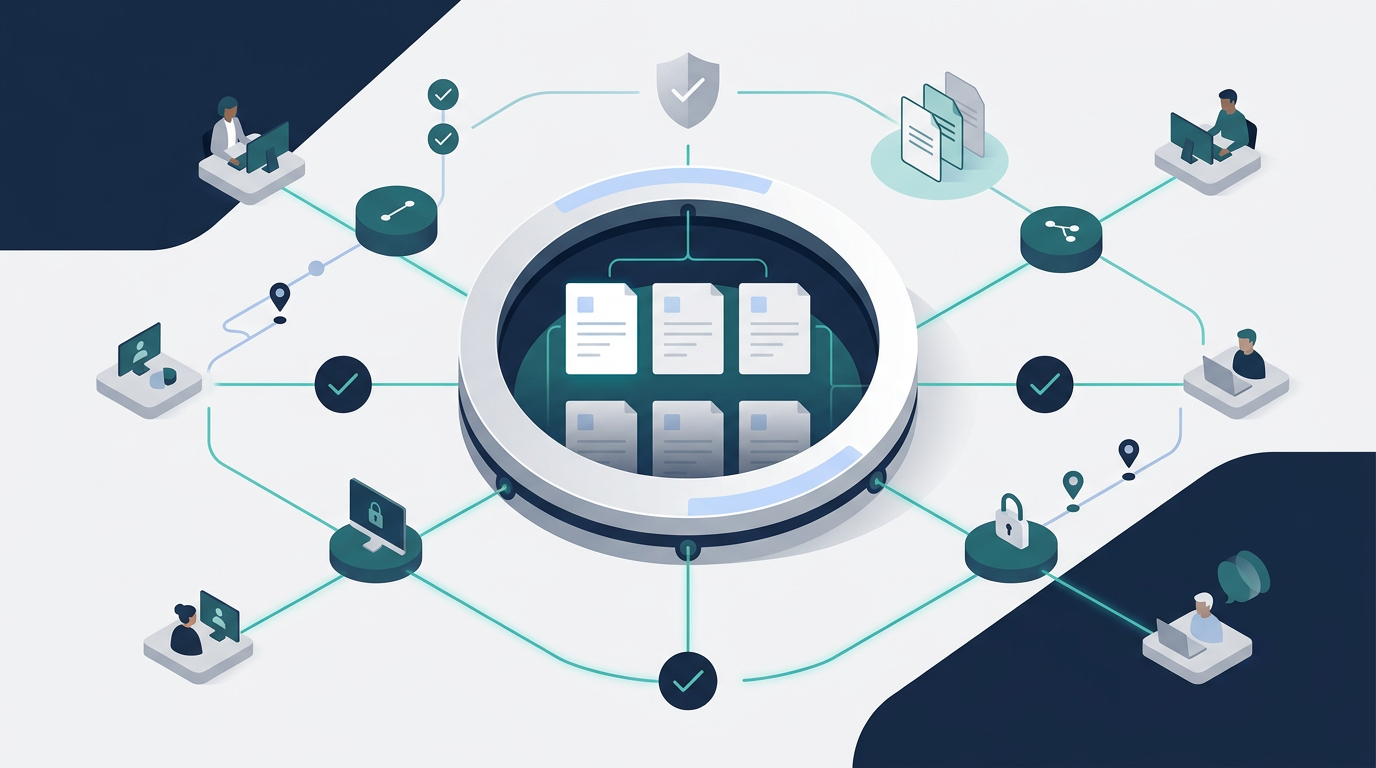
- A central content library is governance infrastructure, not a shared drive. It needs accountable ownership, controlled access, approval evidence, lifecycle management, and retention discipline.
- Advisor adoption determines whether the model works. A tightly governed library that is difficult to search or use will be bypassed.
- A firmwide playbook should connect editorial planning, classification, compliance review, advisor enablement, distribution, CRM integration, and leadership reporting.
- A focused pilot with defined governance is generally a more reliable starting point than a broad rollout that tries to migrate every asset and onboard every advisor at once.
Article at a Glance
Most wealth and asset management firms do not lack content. They lack control over it. Market commentary, client education, presentation materials, campaign assets, and advisor-created communications tend to accumulate across shared drives, inboxes, local folders, portals, and personal devices. The result is a familiar pattern: teams recreate assets that already exist, compliance reviewers revisit similar materials repeatedly, advisors use outdated files because they are easier to find, and leadership has little visibility into what reaches clients.
That pattern becomes more serious as a firm grows. A small practice may manage informal content review through a trusted compliance contact and a handful of shared folders. A larger advisory network, broker-dealer, or enterprise wealth organization needs a more deliberate operating model. Different offices, advisor teams, product lines, client segments, channels, and supervisory requirements create too many handoffs for email and file storage to serve as a dependable control system.
A firmwide content playbook provides that operating model. It establishes how content is planned, sourced, reviewed, approved, classified, distributed, measured, archived, and retired. A central library gives those decisions a practical home. Together, they give marketing, compliance, distribution, and technology teams a common system for supporting consistent client communication without forcing advisors to build materials from scratch.
This is not a technology project disguised as a content project. It is a business infrastructure decision with implications for supervision, advisor productivity, client experience, operational cost, and leadership reporting.
When Content Sprawl Becomes a Leadership Risk
The early signs of content sprawl are easy to dismiss. An advisor asks for the latest retirement planning brochure and receives three different versions. Marketing updates a market commentary template, but older versions remain in circulation. Compliance approves a piece of content for one channel, then receives similar submissions from several advisors who have each made their own edits. A regional office maintains a local folder because the corporate repository is hard to search.
None of these events appears significant in isolation. Together, they reveal a structural problem.
A fragmented content environment makes it difficult to answer basic management questions:
- What client-facing content is currently approved for use?
- Which version is current?
- Which audiences, channels, and use cases does each asset support?
- Who can edit, distribute, or retire a piece of content?
- What disclosures or usage conditions apply?
- What materials were distributed, by whom, and through which approved channels?
- Which assets are being used, ignored, duplicated, or repeatedly sent back for review?
When a firm cannot answer those questions consistently, it has a governance gap. The immediate consequences are wasted time and inconsistent client communication. The longer-term consequences can include supervisory weaknesses, poor recordkeeping, uneven brand representation, and an approval process that becomes slower as the organization grows.
The Cost That Does Not Appear in One Budget
Most firms can see the obvious cost of fragmented workflows. Marketing duplicates work. Compliance queues grow. Advisors spend time searching for usable material. Campaigns launch later than planned.
The less visible costs are often larger:
- Compliance reviewers spend time rechecking standard materials because the firm cannot reliably identify a current approved version.
- Advisors use locally saved files because locating an approved asset requires more effort than using a familiar document.
- Marketing teams build new materials instead of updating or repurposing assets that already exist.
- Distribution leaders cannot tell whether advisors are using approved content or relying on informal workarounds.
- IT inherits shadow repositories and disconnected tools without a clear policy for ownership, security, retention, or integration.
- Executives receive activity reports that show email opens or downloads but do not explain whether the program is improving advisor readiness, client engagement, or operational efficiency.
The firm is not simply paying for content creation. It is paying for coordination failure.
Why Version Control Is a Supervisory Issue
Version control becomes a real risk when advisors and client-facing teams work from multiple copies of the same material. An older version may contain outdated product information, an expired disclosure, a stale market reference, or language that no longer meets the firm’s approval standards.
The problem is not limited to the wrong document being used. The firm also loses the ability to demonstrate which version was approved at the time of use and whether it was distributed under the proper conditions.
For regulated financial-services firms, communication oversight and recordkeeping are not optional administrative tasks. FINRA Rule 2210 sets standards for communications with the public, including requirements that communications be fair, balanced, and not misleading. FINRA also requires firms to retain specified records related to communications and approvals. A content operating model should support the firm’s applicable supervisory procedures, archival practices, and review requirements rather than rely on staff to reconstruct the record after the fact.
That does not mean every piece of content requires the same review process. It means the firm needs documented rules for what has been approved, what may be reused, what needs additional review, what requires escalation, and what records must be retained.
The Adoption Problem Behind the Technology Problem
A central library can have strong permissions, detailed workflows, and sound retention controls. It will still fail if advisors do not use it.
Advisors tend to bypass formal systems for practical reasons. The library may be difficult to search. Content may not reflect the concerns of their client segments. The materials may feel too generic. Access may require several steps. The platform may not work well on a mobile device. Training may have consisted of an announcement and a recorded demonstration.
The appropriate response is not to assume the advisors are resisting governance. In many cases, they are responding rationally to a system that creates friction during a busy client day.
The governance standard and the user experience must reinforce each other. The compliant path needs to be easier than the workaround.
What a Well-Governed Central Library Looks Like
A firmwide content playbook is more than a brand guide, editorial calendar, or style manual. It is an operating model that answers practical questions about how client-facing content moves through the firm.
It establishes:
- What content the firm will create and for whom
- Which content sources are permitted
- How materials are reviewed and approved
- How content is classified and found
- Who can access, modify, publish, or distribute it
- What disclosures, usage rules, and expiration dates apply
- How content activity is connected to advisor workflows and CRM data
- What leadership should monitor
The central library is the infrastructure that makes those decisions usable in daily work.
A Library Is Not a Shared Drive
A shared drive provides storage. A central content library provides governance.
The distinction matters because a folder structure cannot enforce content lifecycle rules, manage review status, restrict editing rights, guide advisors on permitted use, or provide a reliable record of what happened after an asset was approved.
| Capability | Shared Drive or Intranet Folder | Central Content Library |
| Version control | Manual and dependent on user discipline | Current approved version is clearly identified and controlled |
| Access permissions | Often broad and folder based | Role based and tied to content, function, or channel |
| Approval evidence | Often scattered across email threads | Connected to the content item and workflow |
| Search | Dependent on filenames and folder knowledge | Driven by metadata, audience, topic, channel, and use case |
| Expiration management | Manual and easy to miss | Supported through review dates, status controls, and retirement workflows |
| Usage guidance | Separate documents or informal knowledge | Embedded with the content asset |
| Distribution record | Often reconstructed later | Can be linked to approved distribution workflows |
| Leadership reporting | Limited and labor intensive | Supports reporting on content health, adoption, and activity |
A well-governed library should function as a trusted source of approved material. Advisors should know that the content they find is current, relevant to their intended audience, and accompanied by the right usage guidance. Compliance should know where approved versions reside and how they move into distribution. Marketing should know which assets are being used, which are difficult to find, and where content gaps exist.
Content Needs a Lifecycle
Every client-facing asset should have a clear lifecycle. It enters the system through an approved source and review route. It receives an owner, a status, classification tags, relevant disclosures, and a review or expiration date. It is distributed only through approved channels and under defined use conditions. It is refreshed, retired, or archived when it is no longer current.
A practical content record can include:
- Content owner
- Topic and audience segment
- Permitted channel or channels
- Approval status
- Version number
- Approval date and reviewer
- Review date or expiration date
- Required disclosures
- Personalization rules
- Source and usage rights
- Related campaign or client journey
- Distribution limitations
- Retention classification
Not every firm will use the same metadata fields. The principle is consistent: if the firm needs to supervise, find, reuse, report on, or retire content, it needs a reliable way to identify that content and its conditions of use.
Permissions and Workflows Need Precision
Role-based access determines who can do what. It should not be treated as a generic administrative setting.
Marketing may need the ability to upload drafts and manage the editorial calendar. Compliance may need authority to approve, reject, lock, or retire assets. Advisors may need access to approved content within defined categories without the ability to alter the underlying body copy or disclosures. Regional leaders may need visibility into activity without broad editing rights. Technology teams may need administrative access without editorial authority.
Approval workflows should also reflect the actual risk and complexity of the content. A standard, pre-approved educational piece may require a different route from a new product communication, a customized campaign, or material that raises suitability, performance, testimonial, or claims-related questions.
When every submission enters the same review queue, standard content waits behind complex content. When every piece is treated as an exception, compliance becomes a bottleneck by design.
A stronger model uses documented content categories, defined review routes, clear escalation thresholds, and evidence that approvals occurred. This supports efficient review without reducing the firm’s supervisory standards.
Disclosures, Archiving, and Auditability Belong in the Workflow
Governance does not end when a reviewer approves an asset. The firm needs a process for ensuring that required disclosures remain attached, that content is used only in approved contexts, and that records are preserved in line with applicable obligations and firm policy.
That requires discipline in three areas:
| Control Area | Leadership Question | Operating Requirement |
| Disclosures | Are advisors using the right disclosures for the content and channel? | Embed disclosures or enforce them through approved templates and distribution workflows |
| Audit trail | Can the firm identify what was approved, changed, and distributed? | Capture approval, version, access, and distribution information in the operating process |
| Retention | Can the firm preserve and retrieve relevant communications and records? | Align content and communication workflows with applicable recordkeeping policies and archival systems |
Specific legal and regulatory obligations depend on the firm, its channels, its products, and its supervisory structure. Content governance should be designed with the firm’s compliance leadership and counsel. A central library can support those obligations. It does not replace professional judgment, supervisory procedures, or required review.
The Firmwide Content Playbook Framework
The most useful playbooks are built around a limited number of operating decisions. They avoid long policy documents that nobody uses and focus instead on how the work actually moves across marketing, compliance, distribution, advisors, and technology teams.
A practical framework has six connected elements.
Editorial Planning and Content Strategy
The first question is not, “What content do we have?” It is, “What communication does the firm need to support?”
A central library without editorial discipline becomes a larger storage space. It fills with assets that are difficult to distinguish, hard to locate, and disconnected from the client conversations advisors need to have.
Leadership should establish:
- Priority audiences and client segments
- Core client concerns and planning moments
- Content themes that support the firm’s communication strategy
- Channel roles for email, web, social, events, presentations, and advisor follow-up
- A calendar for planned content releases and refreshes
- Clear ownership for editorial decisions
For example, a firm may decide that retirement-income planning, business-owner liquidity events, market volatility, and year-end tax conversations are priority communication areas. That decision then guides what the library needs to contain, how assets should be tagged, and what advisors receive through their regular content cadence.
Approved Content Sourcing and Classification
Content can come from internal teams, licensed providers, approved third parties, research partners, or external subject matter contributors. Each source may require a different level of review, attribution, usage-rights verification, or disclosure management.
The playbook should define approved sources and the conditions for bringing material into the library. It should also establish a consistent classification standard.
Classification is the point where a library becomes usable. Each asset should be tagged in ways that match how advisors search and how the firm supervises:
- Client segment
- Planning topic
- Content format
- Channel
- Approval status
- Region or business unit
- Product or service relevance, where permitted
- Date sensitivity
- Required disclosures
- Personalization allowance
- Expiration or review date
Without consistent classification, search results become unreliable. Advisors then revert to local files, personal networks, and old email threads.
Compliance Review, Supervision, and Version Control
The goal is not to reduce compliance involvement. The goal is to focus review attention where it is most needed.
A strong operating model separates standard, pre-approved content from materials that require a more rigorous review. It defines what advisors can use as provided, what they may personalize within approved fields, and what changes require new approval.
The model should document:
- Content categories and risk levels
- Required reviewers
- Service expectations for routine review
- Escalation triggers
- Rules for material modifications
- Version-locking procedures
- Approval records
- Expiration and retirement rules
This structure helps reduce repetitive review without creating an informal approval culture. It also gives advisors a clear answer when they ask whether they can adapt a piece of content for a specific situation.
Advisor Enablement and Distribution
A library succeeds when it supports the advisor’s actual work.
That means organizing content around client conversations, not only around internal marketing categories. An advisor should be able to find a suitable item for a client concerned about market volatility, a business owner considering a transition, a family approaching retirement, or a prospect who needs an introductory educational resource.
Advisor enablement should include:
- Clear onboarding to the library and its use rules
- Short, practical training based on real communication scenarios
- Search and filtering that reflect advisor language
- Ready-to-use templates and approved personalization fields
- Mobile access where advisor workflows require it
- A formal process for requesting content that does not yet exist
- Advisor champions who can provide peer-level feedback and support
- Feedback loops that identify missing, confusing, outdated, or rarely used content
The best libraries make the approved content path easier than independent creation. That is how firms reduce both advisor burden and the risk of off-platform workarounds.
Distribution and CRM Integration
Approved content creates value only when it reaches the right people through the right channels.
The playbook should define how content moves from the library into email, social, presentations, websites, events, and advisor follow-up. Each channel may have distinct approval, disclosure, archive, and supervisory requirements.
CRM integration adds an important leadership dimension. It helps connect content activity with client records, advisor interactions, opportunities, meeting activity, and other firm-defined business indicators.
It does not create perfect attribution. No CRM configuration can prove that a single email, article, or presentation caused a client to book a meeting or make a planning decision. It does create a better evidence base than counting downloads, opens, or clicks in isolation.
Measurement and Leadership Reporting
Leadership reporting should separate three types of measurement.
| Measurement Area | Questions It Answers | Examples |
| Library health | Is the content system current and governed? | Approval-cycle time, classification completeness, expired assets, version currency |
| Advisor adoption | Are advisors using the approved system? | Active users, search success, content use by advisor group, training completion |
| Content engagement | Are clients interacting with communications? | Opens, clicks, registrations, content shares, website activity |
| Business indicators | Is the program contributing to priority outcomes? | Meetings, opportunities, client retention signals, CRM-linked engagement patterns |
Each category serves a different management purpose. A high open rate does not prove that content is improving client relationships. A high number of assets in the library does not prove advisors can find them. A strong adoption rate does not confirm that content is current or being used through approved channels.
The value of the reporting model lies in showing the relationships among these measures over time.
Content-as-a-Service Changes the Advisor Burden
Many advisory firms expect advisors to act as marketers, writers, editors, designers, and compliance coordinators in addition to serving clients and developing relationships. That expectation creates inconsistent quality and uneven participation.
Content-as-a-service offers a different operating model. It provides a regular flow of approved, useful, and organized content that advisors can deploy in defined ways. The advisor’s role becomes client communication and relationship management, not creating materials from scratch.
This approach can support several needs at once:
- More consistent client outreach
- Reduced advisor content-production burden
- Better alignment between central marketing and field needs
- More predictable compliance review workloads
- Greater reuse of strong content assets
- Better visibility into what advisors are actually using
The standard should not be volume for its own sake. A large library filled with generic content is still difficult to use. The objective is a relevant, current, and well-classified collection that helps advisors communicate consistently in moments that matter to their clients.
Why Editorial Cadence Matters
A predictable editorial calendar helps every part of the operating model.
Advisors know what is coming and can plan outreach rather than react at the last minute. Marketing can build related campaigns and client journeys. Compliance can anticipate review workloads. Leadership can see whether the content program is aligned with business priorities rather than driven by ad hoc requests.
A planned cadence also creates a useful discipline. If a team knows it must support quarterly market commentary, retirement planning conversations, business-owner communication, and seasonal client questions, it can prepare content, disclosures, approvals, and distribution support before demand arrives.
Mobile Access Is an Adoption Requirement
Many advisors work outside a traditional desk environment. They move between client meetings, branch offices, events, and travel. A library that functions only through a cumbersome desktop interface will lose relevance at the point of use.
Mobile access should be evaluated through the lens of supervision and usability:
- Can advisors locate approved content quickly?
- Are permissions and disclosures preserved in the mobile workflow?
- Can the firm maintain appropriate records of distribution?
- Does the workflow prevent unsupported editing or use of outdated files?
- Does the experience reduce the temptation to use personal storage or unapproved channels?
Convenience without control creates a different set of risks. Control without convenience invites workarounds. The platform and operating model need to address both.
A Lower-Risk Path to Implementation
Firms often begin by selecting a platform. That sequence is backward.
Technology should support documented governance decisions, not force the firm to adopt generic defaults. Before selecting or configuring a system, leadership should agree on ownership, content categories, permission levels, review routes, metadata requirements, archive obligations, integration priorities, and reporting needs.
A phased approach allows the firm to test those decisions under real operating conditions.
Start With a Focused Pilot
A pilot should be large enough to test real workflows but narrow enough to manage closely. It might involve a selected group of advisors across a few offices, a limited number of client communication journeys, and a focused set of approved materials.
A useful pilot tests:
- Search and classification quality
- Advisor access and mobile usability
- Approval and escalation workflows
- Disclosure handling
- Onboarding and training
- Distribution records
- CRM or reporting integration
- Advisor feedback
- Content gaps
The purpose is not to prove that every feature works perfectly. It is to identify which governance decisions hold up in daily use and where the operating model needs adjustment before expansion.
Use Advisor Champions
Regional or business-unit champions can make the difference between a platform launch and actual adoption.
These advisors should participate in testing, provide direct feedback on search and relevance, help identify practical use cases, and explain the value of the new workflow in the language of the field. Their role is not to replace formal training or compliance authority. It is to ensure that the design reflects how advisors work and that adoption is supported by credible peers.
Keep Governance Cross-Functional
No single team can operate a firmwide playbook alone.
| Function | Primary Contribution |
| Marketing | Editorial strategy, production, classification, library organization |
| Compliance and legal | Approval authority, supervisory procedures, retention rules, escalation |
| Distribution and advisor leadership | Advisor adoption, training, field feedback, usage expectations |
| IT and digital | Platform security, integration, access controls, archival infrastructure |
| Governance lead | Cross-functional accountability, operating decisions, leadership reporting |
The governance lead does not need a particular title. The role does need authority to resolve cross-functional issues, maintain decision rights, and ensure that the model remains current as the firm changes.
Common Implementation Scenarios
Implementation varies by firm size, structure, and regulatory environment. The following scenarios are illustrative. They show the types of decisions leadership teams commonly face, not guaranteed outcomes.
A Multi-Office Firm With Informal Approval Practices
A multi-office wealth firm relies on email for review and stores approved materials in several regional folders. Advisors have access to most files, but nobody can reliably identify which materials are current.
The firm starts by defining a small set of content categories, assigning owners, and creating a controlled library for its highest-use client communications. Advisors can search by client topic, audience, and channel. Compliance approves and locks final versions. Marketing receives alerts when materials are approaching review dates.
The initial goal is not a complete enterprise migration. It is to establish a dependable source for the assets most likely to be used and to test whether the new workflow reduces repeated review and advisor search time.
An Enterprise Firm With Too Many Content Owners
A large organization has central marketing, regional marketing teams, product groups, advisor teams, and outside content providers. Each group creates useful material. The problem is that content enters the ecosystem through inconsistent review paths and is stored in disconnected systems.
The leadership team develops a common metadata standard, clarifies ownership for content types, and creates permission tiers for different user groups. Regional teams retain the ability to support local needs, but they work within a shared taxonomy, approval model, and content lifecycle.
The critical decision is not whether central or regional teams have more control. It is whether the firm can maintain one coherent governance model while allowing appropriately supervised local relevance.
A Firm Trying to Improve Adoption Without Weakening Controls
A firm already has a content repository, but advisors use it inconsistently. Compliance is reluctant to expand permissions because previous experiences with unsupervised edits created concern.
The firm uses a pilot group to identify why advisors are avoiding the repository. The findings show that the problem is not access alone. The content is poorly categorized, the search tool does not reflect advisor language, and advisors lack approved options for common personalization needs.
The firm responds by improving metadata, creating audience-specific versions, adding controlled personalization fields, and offering scenario-based training. The control framework remains intact, but the user experience improves enough that advisors have less reason to work outside the system.
Frequently Asked Questions
How is a central content library different from a shared drive?
A shared drive stores files. A central content library manages the content lifecycle.
A library should identify the approved version, control access, capture approval history, support search through metadata, apply review or expiration dates, provide usage guidance, and connect content to approved distribution workflows. A shared drive can contain files that support those goals, but it does not provide the operating controls by itself.
Who should own the firmwide content playbook?
The playbook requires shared ownership across functions. Marketing should guide editorial planning and library organization. Compliance and legal should define approval authority, supervisory requirements, and retention rules. Distribution leadership should support advisor adoption and field feedback. IT should manage technology, security, integration, and access controls.
One person or group should own the governance model itself. That role should have enough authority to maintain decision rights, resolve conflicts, and report to leadership on how the operating model is functioning.
How can compliance review be efficient without becoming a bottleneck?
Efficiency begins with classification. Firms should define content types, risk levels, review routes, pre-approved categories, and escalation thresholds. Standard content should not repeatedly enter the same review process if it is being reused without material change and within approved conditions.
The firm should document these decisions and review them regularly. Faster approval should come from clear policy, disciplined workflow design, and better content planning, not from bypassing supervision.
How do firms encourage advisors to use the library?
Advisor adoption improves when the library helps advisors solve immediate communication needs. Content should be relevant, easy to locate, current, and ready for approved use. Search terms should reflect how advisors think about client conversations. Training should focus on real scenarios. Mobile access should be practical where appropriate. Advisors should have a defined path for requesting content that does not exist.
The firm should also monitor usage data and feedback. Low utilization can reveal a training issue, a search problem, a content-relevance problem, or an unnecessary workflow barrier.
Can advisors customize central-library content for their clients?
They can only customize content within the firm’s defined and approved boundaries. Those boundaries may include contact information, approved branding fields, or other limited personalization. Material changes to claims, disclosures, product descriptions, recommendations, or core copy generally require review through the firm’s established process.
If advisors regularly request customization, the firm should examine whether the library lacks sufficient audience-specific content. The solution may be better content design, not broader editing rights.
Can one library support multiple regions or business units?
Yes, if the operating model balances common governance with appropriately supervised variation. The firm can use shared content standards, taxonomy, permissions, and lifecycle rules while applying distinct disclosure requirements, access tiers, approval routes, or content availability where business units or jurisdictions differ.
The central question is not whether every user sees identical content. It is whether the firm can demonstrate consistent control over what each user is permitted to access and distribute.
What should leadership measure?
Leadership should review a combination of library health, advisor adoption, engagement signals, workflow performance, and business indicators.
The most useful reports usually include content currency, approval-cycle time, active users, search success, content use by advisor group, distribution activity, relevant engagement patterns, and CRM-linked indicators such as meetings or opportunity movement where data quality supports that analysis.
No single metric proves content value. A consistent measurement model can show whether the firm is improving operational discipline, advisor participation, and the quality of its evidence over time.
From Content Storage to Content Infrastructure
The first practical step is an honest assessment of the current environment. Identify where content resides, who owns it, how approval is documented, which assets are outdated, where advisors rely on workarounds, and what leadership cannot currently see.
The second step is to choose a focused use case. A small cohort, a limited set of priority communications, and a clear governance model provide a stronger foundation than a broad launch built on unresolved ownership and workflow questions.
FMEX helps financial-services firms assess content governance, central-library readiness, advisor workflows, compliance-review processes, and reporting requirements. Contact FMEX to discuss a compliance-first assessment tailored to your existing technology stack, client communication journey, supervisory requirements, and growth goals.