
Key Takeaways
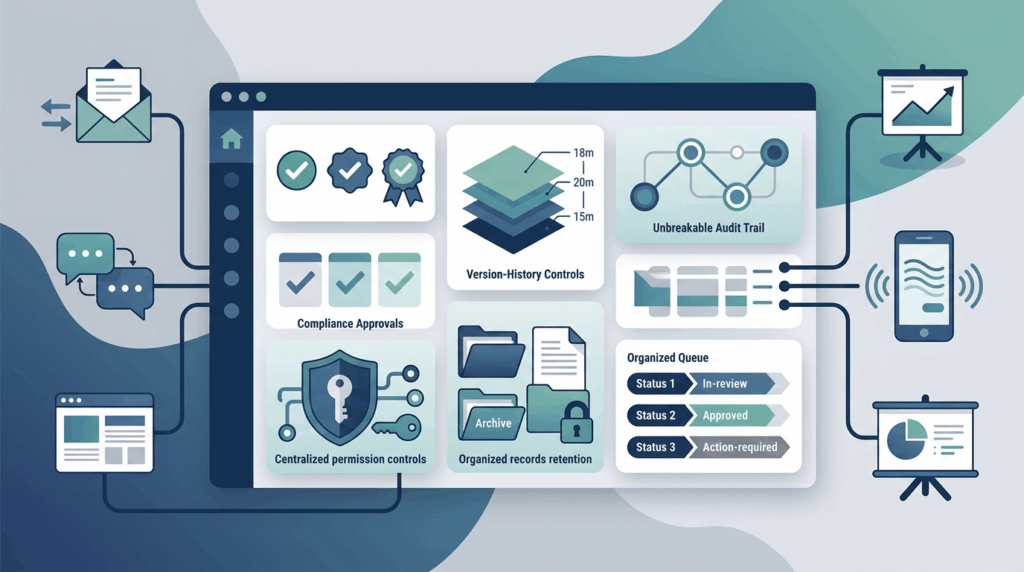
- A compliance dashboard should function as a governance tool, not merely a reporting screen. It should make approval history, version status, archival records, access controls, and exceptions visible.
- Fragmented systems create fragmented oversight. Separate tools for email, social, web, events, and mobile can leave leadership with activity reports but no reliable supervisory record.
- FINRA Rule 2210 and the SEC Marketing Rule establish obligations around supervision, recordkeeping, and evidence retrieval. A dashboard should be designed to support those responsibilities, not replace them.
- Different teams need different views. Compliance, marketing, distribution, advisors, and technology should see the information required for their decisions and responsibilities.
- A practical dashboard assessment starts with seven questions: What is approved? Who reviewed it? What changed? Who can use it? What was distributed? What was retained? Can the firm retrieve the full record when needed?
Article at a Glance
Most compliance dashboards tell leaders what happened. A stronger dashboard shows what is happening now, what was approved, what changed after approval, where records are incomplete, and whether the firm can produce the evidence behind a specific communication.
That distinction matters in regulated advisor marketing. Email, social media, websites, mobile applications, seminar materials, presentations, and other client communications can touch brand reputation, client relationships, supervisory procedures, and recordkeeping obligations at the same time. When each channel is managed in a separate system, firms commonly end up with reports on activity but an incomplete picture of governance.
The issue is rarely a lack of effort. It is usually a system design problem. A marketing team may have a content calendar. Compliance may maintain review records. Technology may archive certain channels. Advisors may have access to approved materials. Yet the firm still may not be able to answer a simple question quickly: What did this advisor distribute, was it approved in the form used, and where is the complete record?
A well-designed compliance dashboard does not replace a firm’s compliance program, designated supervisory personnel, legal counsel, or written supervisory procedures. It gives those functions a more reliable operating view.
Why Most Compliance Dashboards Fall Short
Financial-services firms rarely begin with a fragmented content environment. Fragmentation develops as the organization grows, channels multiply, and different teams adopt tools to solve immediate problems.
Email may be managed in a marketing automation platform. Social posts may be reviewed in a separate compliance tool. Website changes may sit with a digital team. Presentation materials may live in shared drives. Advisors may keep previously approved materials in local folders. Mobile content may be distributed through an application with its own permissions structure.
Each process can seem reasonable on its own. The problem appears when a question crosses systems.
An internal reviewer may need to confirm whether a particular email matched the version that received approval. A compliance officer may need to determine whether a social campaign was archived. A marketing leader may need to identify which content assets are expired. An examiner may request records for a single advisor across multiple channels and a defined period.
If the answers require searching inboxes, shared drives, local files, exports from separate platforms, and staff recollection, the firm does not have a dashboard problem alone. It has a governance problem.
The Difference Between Activity and Supervisory Evidence
Engagement data has value. Marketing and distribution leaders need to understand content reach, usage, and response. Those metrics help teams improve content strategy and identify where advisor communications are gaining traction.
They do not establish that content was properly governed.
| Engagement reporting | Governance reporting |
| Email open rates | Approval status by communication |
| Click-through rates | Version history and effective dates |
| Publishing volume | Exception and override activity |
| Content usage counts | Permission and access changes |
| Campaign reach | Archival completeness by channel |
| Social audience growth | Review queue aging and escalation status |
A campaign with strong engagement may still create a supervisory issue if the final version was not approved, if disclosures were removed, if the content was altered after approval, or if the record cannot be retrieved.
Governance dashboards answer different questions:
- Was the communication approved?
- Who reviewed it?
- Which version was approved?
- What disclosures were included?
- Was the content changed before distribution?
- Which advisors had permission to use it?
- Was the distributed communication archived?
- Can the firm retrieve the complete record?
Those questions matter because supervisory procedures depend on evidence, not on a general belief that a process exists.
The Cost of Manual Reconstruction
Manual processes can work for a small number of advisors and a limited set of channels. They become harder to sustain as content volume and distribution complexity increase.
A firm may have a review process that functions well for standard campaigns but breaks down when an advisor needs localized content, a market event requires a fast response, or a social post is created outside the normal workflow. The result is not always deliberate noncompliance. More commonly, it is a weak connection between approval, distribution, archival, and reporting.
The operational burden becomes visible in several ways:
- Compliance teams spend time chasing records instead of reviewing higher-risk communications.
- Marketing teams do not know which materials remain current and usable.
- Advisors resort to old files or create workarounds when approved content is difficult to find.
- Technology teams struggle to explain which systems are authoritative for specific records.
- Leadership receives summary reports that do not expose unresolved exceptions, retention gaps, or queue bottlenecks.
This is why dashboard design is a leadership issue. The dashboard reflects the operating model behind it.
What Regulators Expect Firms to Support
Regulatory frameworks do not prescribe a universal dashboard layout. They establish obligations around communications, review, supervision, recordkeeping, and the ability to retrieve evidence. Firms determine how their workflows and technology support those obligations based on their registration, business model, communication types, policies, and applicable rules.
For broker-dealers, FINRA Rule 2210 addresses communications with the public, including retail communications, correspondence, and institutional communications. The rule includes standards relating to content, approval in specified circumstances, supervision, and recordkeeping. Firms subject to the rule need to maintain records of communications and, where applicable, records connected to approvals, dates of use, and supporting materials for illustrations, statistics, and other claims.
For registered investment advisers, the SEC Marketing Rule governs advertisements and includes requirements relevant to performance, testimonials, endorsements, third-party ratings, and substantiation. The associated books and records requirements under Rule 204-2 require advisers to make and keep certain records relating to advertisements they disseminate.
A dashboard should not be presented as proof of regulatory compliance. A stronger description is that it supports a firm’s supervisory program by organizing the information that compliance teams, marketing leaders, and designated reviewers need to monitor and retrieve.
What a Dashboard Should Capture
A dashboard designed for governed advisor communications should help the firm connect the lifecycle of a communication:
| Governance question | Evidence the dashboard should help surface |
| What was distributed? | Final communication, distribution channel, date, audience or user context where applicable |
| Was it approved? | Approval status, reviewer identity, review date, workflow history |
| Was the approved version used? | Version history, effective date, edit history, exception status |
| Were required elements included? | Disclosure status, supporting documentation, applicable content rules |
| Who had access? | Role-based permissions, authorized users, permission changes, exceptions |
| Was the communication retained? | Archival confirmation, retention status, retrieval location |
| Can the record be produced? | Exportable history by advisor, communication, campaign, channel, or time period |
The precise recordkeeping requirements vary. Firms should work with qualified compliance and legal professionals to determine which rules apply to their communications and whether their current systems and procedures meet those obligations.
Channel Coverage Is an Ownership Issue
Many firms focus on whether a channel is technically archived. That is necessary, but it is not enough.
A channel can be archived while the approval record sits elsewhere. A social tool can capture published posts without showing whether the final post matched the approved version. A shared drive can store materials without preventing advisors from using outdated copies. A website content management system can retain page history without showing who approved a change or whether the update went through the firm’s review process.
| Channel | Common gap | Governance concern |
| Advisor email | Archived messages are not connected to approval records | The firm cannot readily show whether the message matched an approved version |
| Social media | Review and archival occur in separate processes | The firm may struggle to connect what was approved with what was published |
| Website content | Digital updates occur outside the formal approval workflow | Version history and approval evidence may be incomplete |
| Mobile content | Distribution is managed in a separate application | Compliance may lack visibility into permissions, use, or retention |
| Event materials | Advisors or regional teams manage files locally | The firm may not have a complete record of what was presented or distributed |
The central question is ownership. Every active communications channel should have a defined owner for approval, distribution controls, archival verification, exception management, and evidence retrieval.
The Seven Things a Compliance Dashboard Should Show
There is no single dashboard design that fits every broker-dealer, RIA, bank-based program, or enterprise wealth organization. Still, multi-advisor firms need to answer a common set of governance questions.
The seven areas below provide a practical framework for assessing whether a dashboard supports supervisory evidence, operational accountability, and examination readiness.
1. Approved Content Status and Version History
The content library is the starting point. Advisors need a clear answer to a basic question: Is this material currently approved for my use?
The dashboard should show:
- Current approval status
- Effective date and expiration or retirement date where applicable
- Approved audience, role, jurisdiction, or channel restrictions
- Current version and prior version history
- The person or function that approved the material
- Relevant disclosures and supporting documentation
- Whether retired materials remain accessible
Version control is particularly important. When a communication has been updated, a firm needs to distinguish the active approved version from older versions that may still exist in inboxes, shared folders, downloaded files, or advisor-managed materials.
2. Approval Queues and Review Capacity
Approval workflows can create unnecessary risk when they become opaque. Advisors who do not know the status of a submission are more likely to use an older asset, delay a timely communication, or seek an informal workaround.
A governance dashboard should show:
- Queue volume by content type, channel, or reviewer
- Reviewer assignment and current status
- Time in queue
- Items approaching or exceeding internal review targets
- Escalations and unresolved submissions
- Rework and return rates
- Turnaround patterns over time
The trend matters more than the snapshot. A compliance function that keeps pace under normal conditions but develops a large backlog during quarter-end, market volatility, or campaign launches has a capacity issue that leadership should see early.
3. Permissions and Distribution Controls
Not every advisor should have access to every material. Content permissions should reflect the firm’s policies, the advisor’s role, approved channels, jurisdictional requirements, and the intended use of the material.
The dashboard should make visible:
- Authorized users by role, region, or business unit
- Channel permissions
- Restricted or limited-use content
- Permission changes and approvals
- Temporary access exceptions
- Users attempting to access or distribute unavailable content
Permissions are not just an information-technology control. They are part of content governance. If access rules are invisible or difficult to audit, the firm cannot confirm that its stated controls are functioning as intended.
4. Exceptions and Changes to Approved Content
Pre-approved content is approved in a defined form. If an advisor changes wording, removes a disclosure, adjusts an illustration, or repurposes content for another channel, the original approval may no longer apply.
The dashboard should show:
- Changes made to approved materials
- Whether a modified version was resubmitted for review
- Exception type and status
- Reviewer decision and resolution date
- Distribution activity before resolution
- Recurring patterns by team, advisor group, content type, or channel
The purpose is not to treat every modification as misconduct. Advisors may need approved flexibility to tailor communications. The governance requirement is that changes remain visible, documented, and routed through the firm’s defined process.
5. Supervision Coverage Across Channels
A firm can authorize email, social, websites, mobile tools, and presentations while still having meaningful supervision gaps. Channel access is not the same as channel coverage.
The dashboard should help leadership confirm:
- Which channels are active
- Which channels operate within a supervised workflow
- Whether content is reviewed according to the firm’s procedures
- Whether archival is functioning consistently
- Which advisor populations are active in each channel
- Where activity occurs outside the intended workflow
- Which channels require manual reconciliation
This view gives compliance and technology leaders a basis for prioritizing improvements. Not every gap requires an enterprise-wide replacement program. Some can be addressed through clearer ownership, tighter workflows, integration work, or a focused pilot.
6. Archival and Recordkeeping Completeness
Retaining the final communication is important. Retaining a usable record of how that communication was approved, changed, distributed, and archived is more useful.
A dashboard should distinguish between:
- Communications retained automatically
- Communications requiring manual archival
- Records with complete approval documentation
- Records missing reviewer, version, disclosure, or distribution details
- Channels with confirmed retention coverage
- Channels with unresolved archival gaps
- Records that can be retrieved without manual reconstruction
This is where many organizations discover the difference between storing information and managing an evidence record.
7. Examination Ready Reporting
A dashboard is only as useful as the firm’s ability to retrieve information when needed. Leadership should be able to ask for a specific record and receive a clear response without assembling a temporary investigation team.
The firm should be able to retrieve governance evidence by:
- Advisor or representative
- Content asset
- Campaign
- Channel
- Reviewer
- Exception category
- Date range
- Business unit or region
A complete record should connect the distributed communication to its approval history, version, applicable disclosures, supporting documentation where relevant, distribution details, archival confirmation, and any exception activity.
The objective is not to promise a particular examination outcome. It is to reduce the manual burden of finding, reconciling, and explaining records.
Role Specific Views Create Better Accountability
A single dashboard view rarely serves every role well. The CCO, marketing leader, head of distribution, advisor, and technology owner make different decisions. They should not need to sort through the same volume of information to find what matters.
| Role | Primary need | Useful dashboard view |
| Chief Compliance Officer or General Counsel | Enterprise oversight and supervisory evidence | Queue aging, unresolved exceptions, archival completeness, channel coverage, escalation status, retrieval readiness |
| Marketing leadership | Content lifecycle and workflow efficiency | Approval status, revision rates, content expiration, review turnaround, current inventory, time to publish |
| Head of Distribution or Wealth Management | Advisor adoption within governed workflows | Authorized access, content use by approved channel, workflow adoption patterns, regional gaps |
| Individual advisor | Clear and practical guidance | Available approved content, permitted channels, submission status, expiration alerts |
| Technology owner | System integrity and data coverage | Integration health, access logs, retention coverage, data completeness, workflow dependencies |
Role-specific views make accountability more practical.
A CCO needs an early warning system. The focus should be on unresolved exceptions, aging queues, incomplete archival, and channels where the firm cannot quickly retrieve records.
Marketing leadership needs to understand where production is slowing, which content is nearing retirement, and whether recurring rework signals a problem with content design or review expectations.
Distribution leaders need insight into whether advisors are using approved materials and whether low adoption reflects poor relevance, limited awareness, difficult workflows, or inadequate enablement.
Advisors need simplicity. They should be able to find approved materials, understand what they can use, submit questions or modifications, and see the status of pending reviews. A complicated advisor interface increases the temptation to work outside the intended process.
Technology leaders need a clear view of where data moves, where it stops, and which systems are responsible for archival, approvals, permissions, and retrieval.
What Dashboard Gaps Look Like in Practice
The following composite scenarios illustrate common operating patterns. They are not client case studies and do not predict outcomes for any firm.
A Mid-Size RIA With No Centralized Approval Workflow
Consider a registered investment adviser with 40 advisors across six states. Marketing creates educational content, a compliance officer reviews it by email, and approved files are stored in a shared drive. Advisors receive a notification and download what they need.
The process appears workable. It becomes difficult when a specific communication must be traced.
An advisor may have used an older file stored locally. Another may have made a local edit to the approved version. A third may have distributed content through an email platform that is archived but not connected to the original approval record.
If an internal review or regulatory request asks for the complete communication history of one advisor over a six-month period, the firm must reconstruct the answer from email threads, shared-drive files, advisor records, and archival exports.
| Current approach | Governed workflow |
| Approval documented in email | Approval captured with reviewer, date, and version history |
| Content distributed through a shared drive | Advisors access the current approved version through a governed library |
| Advisor edits remain invisible | Changes are flagged and routed for review |
| Archival depends on separate manual steps | Archival status is connected to distribution activity |
| Records require manual reconstruction | Records can be retrieved by advisor, channel, content, or date range |
The point is not that every firm requires an immediate technology replacement. The point is that leadership should understand where the evidence chain breaks.
A Broker-Dealer With Overlapping Point Tools
Consider a broker-dealer with a social compliance tool, an email archive, a content management system, and a separate approval workflow. Each system is functioning as intended. The problem is the absence of a shared record.
The social tool can show that a post was reviewed. The content management system can show where an asset was stored. The email archive can show that an email was sent. The approval tool can show that a draft was approved.
What none of the systems can show on its own is whether the email or social post distributed by a particular representative matched the approved version, whether the required disclosures were included, and whether the full record is retrievable in one place.
The compliance team can still answer the question. It just requires manual work across systems, matching reports that may use different identifiers, and relying on individuals to explain workflow steps that were never captured as structured data.
This is where a unified governance approach has value. It is not simply a reporting convenience. It reduces the number of handoffs required to establish a reliable record.
When Engagement Reporting Hides Governance Risk
A marketing dashboard may report strong campaign delivery, content adoption, and advisor usage. Those are useful signals.
The same firm may also have a growing queue of unreviewed submissions, materials approaching expiration, permission changes that have not been reviewed, and a social channel with incomplete archival coverage.
If leadership sees only engagement indicators, the organization can appear healthy while supervisory pressure accumulates in the background.
A more balanced dashboard does not eliminate that pressure. It makes the pressure visible early enough for the firm to decide how to respond.
Questions Leaders Should Ask Before Choosing a Platform
Technology evaluation should begin with the operating model, not a feature list. A platform cannot resolve unclear ownership, inconsistent supervisory procedures, or a lack of policy alignment. It can, however, support a stronger workflow when those foundations are in place.
Leaders should ask:
- Can the platform show the full lifecycle of a communication from creation through review, approval, use, archival, and retrieval?
- Which channels are covered directly, and which require integration with another system?
- Can the firm distinguish between approved content, modified content, expired content, and retired content?
- How are advisor edits detected and routed for review?
- Can the system record reviewer identity, approval date, version history, and applicable disclosures?
- How are role-based permissions configured and audited?
- How are records exported for a specific advisor, campaign, communication, channel, or time period?
- Which retention functions are automated, and which depend on manual processes?
- How does the platform integrate with the firm’s CRM, email systems, archival tools, content repositories, and identity-management controls?
- What implementation work is required from compliance, marketing, distribution, and technology teams?
The right answer will vary by firm. A smaller RIA may begin by standardizing a high-risk workflow and replacing manual approval records. A larger broker-dealer may need an enterprise review of integrations, archival coverage, permissions, and data ownership before considering consolidation.
Frequently Asked Questions
Does a compliance dashboard replace the review process?
No. A compliance dashboard supports visibility, workflow management, exception monitoring, recordkeeping, and evidence retrieval. It does not replace designated supervisory personnel, principal reviewers, written supervisory procedures, legal counsel, or human judgment.
A useful dashboard helps compliance teams focus their attention. It can show a growing review backlog, repeated edits to approved content, missing archival records, or a channel that is operating outside the intended workflow. The response to those signals still requires a qualified person and a firm-specific process.
How is a compliance dashboard different from a CRM report?
A CRM report is typically designed around client relationships, pipeline activity, meetings, and service workflows. A compliance dashboard is designed around governance evidence.
The difference is material. A CRM may show that an advisor contacted a prospect. It may not show whether the communication was approved, whether the advisor used the approved version, whether disclosures were included, or whether the final content was retained with its review history.
Both types of reporting have value. They should not be treated as substitutes.
What should count as an audit trail?
The answer depends on the firm, its registration, the type of communication, and applicable requirements. In practical terms, a useful audit trail for a client-facing communication should enable the firm to identify the communication in the form distributed, its date and channel of distribution, relevant review and approval evidence, the version used, any substantive changes, applicable disclosures, and the location or status of the retained record.
A final PDF or archived email alone may not provide a complete evidence record if it cannot be connected to the approval process or the version that was actually used.
Can advisors have their own dashboard view?
Yes. Advisors should generally have a role-based view that shows only the information they need to use approved content confidently.
That view may include the current approved content library, permitted channels, submission status, expiration notices, and guidance on requesting changes. It should not require advisors to navigate enterprise-level exception reports or firm-wide compliance data that falls outside their responsibilities.
A simpler advisor experience supports adoption of the governed workflow.
How can a firm test examination readiness?
A practical test is to simulate a record request. Select one advisor, one date range, and one or more active communications channels. Then attempt to retrieve the complete governance record for all relevant communications.
The test should include the final communication, approval history, version details, disclosures, distribution record, archival status, and any exceptions. If the process takes days, requires multiple staff members, or produces uncertain gaps, the firm has identified an area for improvement.
Does every dashboard need to cover every channel immediately?
No. Firms should prioritize based on risk, communication volume, advisor population, current recordkeeping gaps, and the maturity of their technology environment.
A focused pilot can be more useful than an enterprise-wide rollout that lacks ownership or adoption. The important point is that leadership understands which channels are governed today, which are only partially governed, and which remain outside a reliable evidence chain.
A Clearer View of Content Governance
The strongest first move is not selecting a platform. It is mapping the firm’s active communications channels and asking who owns approval, permissions, archival, exception handling, and evidence retrieval for each one.
Bring compliance, marketing, distribution, and technology into the same conversation. Compare the process that each team believes exists with the actual path a communication follows from creation through distribution and retention. Then test whether the firm can produce a complete record without relying on inbox searches, local files, or staff memory.
Financial Media Exchange can help firms assess that operating picture through a compliance-friendly content audit. The review can identify where existing workflows are producing reliable supervisory evidence, where ownership or records are incomplete, and whether a more integrated content governance approach would fit the firm’s technology stack, advisor journey, and business goals.