
Key Takeaways
- Generic software RFPs rarely surface the governance, supervision, and archival capabilities that regulated wealth and asset management firms need from a content platform.
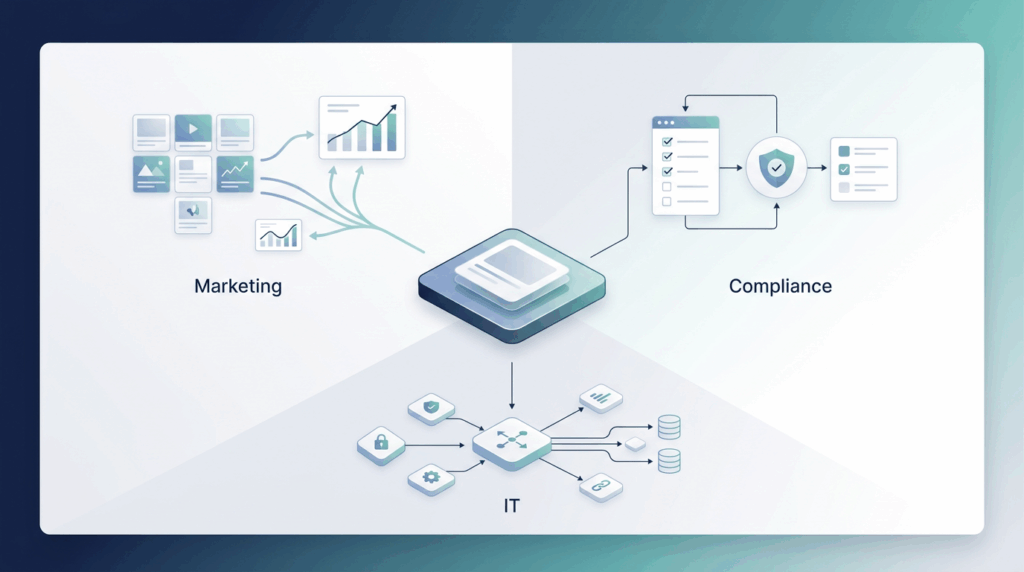
- Marketing, compliance, IT, and distribution each define failure differently, so all four functions need to shape RFP requirements before any vendor questions are written.
- The most consequential RFP questions focus on workflows and operating model, not feature checklists, especially for approvals, advisor edits, recordkeeping, and integrations.
- Vendor claims about compliance readiness or seamless integration must be backed by evidence, including technical documentation, audit trail samples, and customer references.
- Firms remain fully responsible for their supervisory programs and recordkeeping; the platform can support that responsibility, but it does not replace it.
Article at a Glance
Most content platform RFPs are written as if the firm were buying another generic software tool. They ask about uptime, licensing, and APIs, yet they skim past the supervision workflows and archival controls that regulators will examine when something goes wrong. The result is predictable. The selected platform looks fine on paper, passes internal procurement checks, and then fails either in the field or in the exam room.
The gap is structural. Marketing, compliance, IT, and distribution rarely align their requirements before the RFP goes out. Each team assumes its concerns are obvious, and each expects the others to raise their issues later in the process. That “later” usually arrives after contracts are signed and rollout has started. At that point, governance gaps and adoption problems are expensive to fix and politically hard to admit.
A leadership grade RFP for a content platform has a different job. It must capture the firm’s real operating model, current weaknesses, and risk appetite. It must probe workflows, data flows, and adoption realities, not just feature lists. It must also give vendors a precise picture of what “good” looks like in your environment so their responses can be compared on more than price and promises.
For regulated wealth and asset management firms, the RFP is not paperwork. It is the first concrete expression of how the firm intends to govern advisor communications, connect content to pipeline, and align marketing ambition with regulatory reality.
Why Traditional RFPs Fail Content Platforms
Generic Software RFPs Miss Governance and Regulatory Risk
The standard enterprise software RFP template was never designed around regulated financial content. It asks sensible questions about uptime, data centers, licensing models, and API availability. Those questions still matter. They do not, however, test whether the platform can support a supervised content program under FINRA, SEC, IIROC, or FCA style expectations.
Generic RFPs treat content management primarily as a storage and distribution problem. They ask how content is organized, how it can be sent, and how usage is reported. They rarely ask how content is reviewed and approved before it reaches clients, how advisor changes to approved content are controlled and logged, or how the firm will prove in an examination that its oversight process worked as described.
Under FINRA Rule 2210 and the SEC Marketing Rule, firms carry ongoing responsibility for the accuracy, fairness, and supervision of retail communications and advertisements. A content platform either supports that responsibility or makes it harder to meet. An RFP that does not ask about pre approval workflow configuration, role based content modification, and exportable audit logs is not evaluating supervision architecture at all. It is evaluating a different category of product.
How Incomplete RFPs Create Shelfware, Compliance Gaps, and Integration Debt
When RFPs skip adoption requirements and integration depth, firms tend to see two compounding outcomes.
First, advisors discover that the platform does not fit their real workflow. It may work well at a desk, yet feel slow or awkward on mobile between meetings. Tasks that should take minutes take much longer. After a short trial, advisors revert to old habits. The platform becomes shelfware.
Second, because integration requirements were not enforced, the platform sits outside the firm’s CRM, email archiver, and identity systems. Content use and client communications now live in a partial, parallel record. Compliance teams cannot easily search, supervise, or produce a complete history during exams, and data teams must stitch reports together manually.
Shelfware in this context is not only a sunk cost. It is a governance problem. Some advisors will use the platform and its approved content, others will not. Leadership has limited visibility into who sits in which camp or how that maps to risk.
Integration shortcuts add another layer of risk. When a content platform does not connect cleanly to CRM or archival systems, IT teams often build custom connectors, scheduled exports, or manual upload routines. Those stopgaps have their own failure modes, are rarely documented well, and depend on a small number of people who understand them. An RFP that had probed APIs, data ownership, and the vendor’s integration roadmap earlier would have brought these issues to the surface before contracts were signed.
What a Modern Content Platform RFP Must Actually Cover
A leadership grade RFP for a regulated content platform needs to test six domains. Each domain maps to a different failure mode and a different stakeholder.
| Domain | Core focus | Primary owner |
| Content governance and supervision | Pre approval workflows, content modification controls, audit logs, exam ready reporting | Compliance and legal |
| Original content quality and library depth | Financial specificity, segment alignment, editorial standards | Marketing |
| Advisor UX and mobile field enablement | Mobile performance, ease of use, onboarding, training, field workflows | Distribution and field leads |
| CRM, archival, and identity integration | Native connectors, APIs, data flows, ownership, identity and access management | IT and data |
| Analytics and distribution measurement | Engagement metrics, pipeline signals, reporting into existing dashboards | Marketing and distribution |
| Implementation support and vendor stability | Rollout plan, support model, security posture, financial and operational resilience | Executive sponsors and IT |
Content governance and supervision architecture covers how the platform handles approvals, who can change content, how changes are tracked, and what evidence is available for exams.
Original content quality and library depth focuses on whether the vendor produces financial content that matches your advisor personas and client segments, or primarily aggregates third party material.
Advisor UX and mobile enablement examines whether the platform actually works where advisors work, especially on mobile, with realistic support and training.
CRM, archival, and identity integration tests whether the platform will live inside your existing infrastructure, with clear data ownership and supportable interfaces.
Analytics and measurement checks whether engagement and usage can be connected to advisor behavior and pipeline, rather than ending at opens and clicks.
Implementation support and vendor stability determines whether the vendor can help your firm deploy, evolve, and secure the platform across the lifecycle, not just during a pilot.
Why Marketing, Compliance, IT, and Distribution Each Need a Seat
Each stakeholder group brings a different definition of failure.
- Marketing sees failure when advisors ignore the platform, campaigns do not reach clients, and content spend cannot be tied to meetings or pipeline.
- Compliance sees failure when unapproved or unarchived content surfaces in an exam, or when the firm cannot demonstrate how supervisory reviews were performed.
- IT sees failure when the platform cannot be secured, lacks modern identity controls, or requires constant custom engineering to stay connected.
- Distribution sees failure when advisors keep relying on ad hoc, shadow content practices because the platform does not fit their day.
If only one group drives the RFP, the platform will likely perform well on that group’s criteria and poorly for the others. The RFP is the main structured opportunity to reconcile these definitions of success before vendor selection. Without that alignment, disagreement simply shifts downstream into rollout, governance committees, and remediation projects.
The remedy is simple and demanding. All four groups must directly contribute to the requirements document, not just attend vendor demos. Each domain in the RFP table above should have a named internal owner and a clear set of questions they are accountable for shaping.
Diagnosing Your Current State Before You Draft the RFP
Before any vendor questions are written, leadership needs a clear view of current content operations. The goal is not to justify a platform purchase. It is to decide which problems must be solved first, which existing strengths must be preserved, and where the greatest regulatory and commercial risk sits today.
Seven Signals That Your RFP Is Overdue
- Advisors routinely source or create their own content outside any centralized approval process.
- Compliance cannot produce a complete archive of advisor client communications for a defined period without significant manual work.
- Marketing cannot see which content pieces are being used and which sit untouched in shared drives or portals.
- The firm runs multiple tools for content creation, distribution, archival, and analytics, with little or no integration between them.
- Onboarding new advisors to content programs takes weeks and requires direct IT involvement.
- The firm has received exam observations or deficiency letters tied to communications supervision or recordkeeping in recent years.
- Advisors report that official tools do not work reliably on mobile, so they default to personal workarounds.
These signals suggest that the platform decision is not a “nice to have” technology refresh. It is a structural change in how advisor communications are governed and executed.
Internal Alignment Questions to Answer First
If internal questions on scope, budget, risk tolerance, and decision authority remain vague, the RFP will encode that vagueness. Vendors will respond, but their proposals will reflect the ambiguity. The evaluation then becomes a debate about preferences rather than a structured assessment of fit.
Key dimensions to resolve include:
- Scope
- Which advisor segments and regions will be in scope for phase one.
- Which channels (email, social, events, portals, mobile) must be supported at launch versus later.
- Budget
- The realistic range for licenses, implementation, and ongoing support.
- Where tradeoffs are acceptable, for example volume of content versus advanced analytics.
- Risk tolerance
- How much integration risk the firm is willing to accept if some connectors require configuration rather than turnkey deployment.
- How much change advisors can absorb during rollout, and what that implies for training and support.
- Decision authority
- Who has final signoff on vendor choice.
- Which criteria that person will treat as non negotiable versus negotiable.
Aligning on these points first turns the RFP into a sharper instrument. Without that work, the document collects unprioritized requirements, and scoring becomes arbitrary.
What Good Looks Like in a Unified Content Platform
It is easier to write and score RFP questions when everyone shares a concrete picture of the target state. For a regulated advisory firm, a modern unified content platform should look like this in daily practice.
Compliance View
- All distributed content either comes from a pre approved library or passes through a documented review workflow.
- Advisor edits to approved content are constrained, logged, and visible in audit trails.
- Records are archived automatically, indexed for search by advisor, date, and content type, and can be exported in exam ready formats without manual rebuilding.
Marketing View
- A large, financial specific content library is organized by segment, channel, and topic, with a clear editorial cadence.
- Campaigns can be configured for different advisor groups and channels, with consistent use of pre approved content.
- Engagement data feeds reporting tools so that marketing can see how content translates to advisor activity and client conversations.
Advisor View
- The platform runs reliably on mobile and desktop, with straightforward workflows for finding and sharing content.
- Advisors can see which pieces are ready to send, which require additional review, and which are not available for modification.
- Guidance is available on when and how to use specific content pieces to support real client conversations.
IT View
- The platform uses modern identity controls, including SSO and MFA, and fits the firm’s security architecture.
- Integrations with CRM, archival systems, and file repositories are supported and documented.
- Data ownership, retention, and residency commitments are clear in contracts.
This description is not a wish list. It is a practical definition of the environment regulators expect and that advisors will actually use. Each RFP section should trace back to one or more of these perspectives.
Essential RFP Questions for Marketing Leaders
Move Beyond Feature Lists
Marketing leaders frequently begin with feature lists, focusing on content volume, design flexibility, and campaign tools. Those elements matter, yet they do not decide whether advisors will use the platform or whether leadership can see clear links between content, meetings, and revenue.
A better starting point is outcomes. For example:
- After twelve months, how many advisors are expected to be active monthly users, by segment.
- Which channels the firm expects to support and how frequently advisors should be communicating.
- How leadership expects to see content impact reflected in CRM or pipeline dashboards.
Framing RFP requirements through those outcomes forces vendors to describe how their platform supports adoption and measurement, not just what it can do in a demo.
Marketing should also be explicit about original content versus aggregation. A vendor that produces original financial content aligned to regulatory expectations solves a different problem than a vendor that curates general market commentary from external sources. The RFP should state which model the firm wants, then ask questions that match.
Content Strategy and Personalization Questions
Key questions for the content library include:
- How the library is structured by client segment, topic, and channel.
- How often each category is updated and who is responsible for editorial oversight.
- Whether content supports multiple advisor personas and firm types, not just a single communication style.
The goal is not to chase library size. It is to understand whether advisors will be able to find relevant, timely, and compliant content for their clients without wading through noise.
Advisor Adoption and Engagement Analytics
Advisor adoption is the real determinant of marketing return. RFP questions should probe:
- The end to end advisor workflow from mobile login to sending content.
- Onboarding time for a new advisor without IT support.
- Training resources, including role specific modules for advisors and administrators.
- Typical adoption and active usage rates, by firm segment, drawn from anonymized customer data.
Analytics questions should extend beyond opens and clicks. Marketing leaders need to know:
- Whether content interactions can be linked to CRM records and contact histories.
- What dashboards or exports are available to show content assisted meetings or opportunities.
- How the platform defines an active user and whether that definition can be aligned with internal benchmarks.
Essential RFP Questions for Compliance and Legal Leaders
Focus on Evidence, Not Promises
RFP responses for governance and supervision should be evaluated on evidence. Compliance questions should request:
- Demonstrations of pre approval workflows, including configuration screens.
- Sample audit exports showing how content, approvals, and distributions are recorded.
- References from compliance officers at similar firms who have used the platform in actual exams.
Statements such as “supports FINRA Rule 2210” or “designed for SEC registered firms” may be sincere, yet they do not show how the platform behaves in real work. The RFP should make clear that the firm remains responsible for its supervisory program and is evaluating whether the platform gives the team the tools and records they need.
Supervision, Approvals, and Audit Trails
Key supervision and approvals questions include:
- Whether pre approval workflows can be configured by content category and advisor group.
- Who can administer and change workflow rules and what approvals are required for changes.
- How multi step approvals are supported and how re approvals are handled when content is modified.
- How approval requests are routed and what happens when approvers do not respond within defined timelines.
Audit trail questions should cover:
- What metadata is captured when content is sent, including advisor identity, client segment, and timing.
- How long records are retained and in what formats they can be exported.
- What happens to records if the firm ends the relationship with the vendor, including retention and access after termination.
These questions help compliance teams distinguish between platforms with supervision built into their core model and those that rely on manual workarounds.
Essential RFP Questions for IT and Security Leaders
Architecture, Integrations, and Data Flows
IT leaders need to understand how the platform will fit the existing stack and security posture. RFP questions should explore:
- Which CRMs, archival systems, and identity providers the platform supports with native integrations.
- How data flows between the platform and other systems, including any middleware or third parties.
- How content and engagement data can be exported or accessed through APIs for use in internal reporting and analytics.
- Data ownership terms, including how and where data is stored and what happens at contract end.
These questions surface where the platform aligns with existing architecture and where customization or change will be required.
Security, Privacy, and Mobile Controls
Security and privacy questions should address:
- Encryption standards for data in transit and at rest.
- Identity and access management, including SSO, MFA, and role based permissions.
- Availability and format of access logs for internal audits.
Vendors should be asked to provide current SOC 2 Type II reports, with clarity on audit scope, as well as information on penetration testing cadence and incident response processes.
For mobile use, IT and security teams need to know:
- How devices are onboarded and offboarded, including controls for wiping or disabling access when advisors leave.
- Whether the platform supports secure browsers, whitelisting, and other controls appropriate for regulated environments.
- How mobile app updates are tested and deployed within the firm’s mobile device management policies.
Security incidents are not automatically disqualifying. Silence or evasiveness about how incidents were handled is a stronger warning sign.
A Practical Scoring Framework for Comparing Vendors
Collecting RFP responses is the midpoint, not the finish line. The evaluation team still has to turn those responses into a defensible decision. A structured scoring framework helps prevent decisions from being driven by whoever argues most convincingly in the final meeting.
Building a Cross Functional Scoring Matrix
A practical approach is to build a matrix around the six domains defined earlier. Each domain receives a weight that reflects the firm’s risk profile and strategic priorities. Within each domain, specific capabilities are listed with scoring criteria on a defined scale, often one to five.
For example:
- Governance and supervision might carry 30 to 40 percent of the total score for a firm with recent exam findings.
- Advisor UX and adoption might carry a higher weight in firms where previous platforms failed because advisors did not engage.
- Integration and security might be weighted higher where the technology stack is already complex and under strict oversight.
Mandatory capabilities should be flagged separately. If a vendor cannot meet mandatory requirements, such as automatic archival of distributed content or SSO support, they should not advance regardless of strengths elsewhere.
Red Flags in Vendor Responses
While scoring, teams should watch for patterns that signal risk. Examples include:
- Vague answers about compliance, such as “we support all major regulations” without specifics.
- Reliance on roadmaps rather than current capabilities for key controls.
- Lack of customer references in similarly regulated environments.
- Overuse of marketing language in response to technical or governance questions.
Raising these red flags during evaluation, and documenting the discussion, gives leadership a clearer view of the tradeoffs they are being asked to accept.
Scenarios From the Field
Scenario One: Shelfware and Supervisory Gaps
A mid sized broker dealer selected a content platform based on an RFP written primarily by marketing and procurement. The questions emphasized content volume, design flexibility, and licensing cost. Compliance and IT provided only high level comments and did not contribute detailed requirements.
Within the first year, the platform’s library delivered the promised volume. Advisors, however, found the workflows slow on mobile. Many continued to use personal templates and legacy tools. The platform captured some content activity; other communications remained scattered across email and shared drives.
During a routine review, regulators requested evidence that advisor communications had been supervised and archived consistently. The firm could show detailed records for content sent through the platform, but not for off platform communications. The supervisory program now had two parallel tracks, only one of which the firm could document fully. The platform was technically in place, yet it did not solve the governance problem the firm believed it was buying.
Scenario Two: Alignment First, Platform Second
A large RIA network started its RFP by convening marketing, compliance, IT, and distribution leaders. They agreed on a narrow initial scope: a subset of advisors and channels, with a clear plan to expand. They defined mandatory capabilities for supervision and archival, minimum standards for integrations, and adoption goals for the first year.
Those requirements shaped a detailed RFP, including requests for workflow demonstrations and sample audit exports. Vendors were scored against a matrix that weighted governance, adoption, and integration heavily. Some visually impressive platforms were eliminated early because they could not support exam ready reporting or modern identity controls.
When the selected platform was rolled out, advisors received role specific training, and adoption was tracked against the agreed benchmarks. Compliance tested export processes before go live, and IT connected the platform into CRM and archival systems with documented configurations. As a result, leadership could see both content usage and downstream activity in familiar dashboards. The platform did not eliminate supervisory work, but it made that work more structured and measurable.
Leading the RFP as a Strategic Decision
For senior leaders, a content platform RFP is less about software selection and more about operating model design. The questions you choose, the evidence you demand, and the weights you assign tell your teams and regulators what you value and how you intend to govern advisor communications.
The most effective leaders treat the RFP as an early test of cross functional alignment. They insist that marketing, compliance, IT, and distribution all contribute, that adoption and governance receive equal attention, and that vendor claims are backed by proof. They view the platform not as a shortcut to compliance or growth, but as infrastructure that supports disciplined, measurable communication with clients.
When you treat the RFP with that level of seriousness, the platform you select is more likely to support the firm’s long term goals, withstand regulatory scrutiny, and earn advisors’ trust in the field.
Putting This Into Practice
The first step is internal. Bring marketing, compliance, IT, and distribution leaders into a working session to map your current state, define mandatory requirements, and agree on how success will be measured. Capture that alignment in a structured RFP that tests workflows, governance, adoption, and integration in equal measure.
From there, you can pressure test your assumptions against the market and see how vendors respond. If you want a partner to help you assess your current content stack and governance model, and to design a cross functional RFP that reflects your supervisory obligations and growth goals, you can invite the FMEX team into that conversation. They can work with your marketing, compliance, and IT leaders to run a compliance first evaluation of your existing tools, advisor journeys, and integrations, then outline how a modern content platform and Content as a Service program would support your specific advisor base and regulatory environment.